

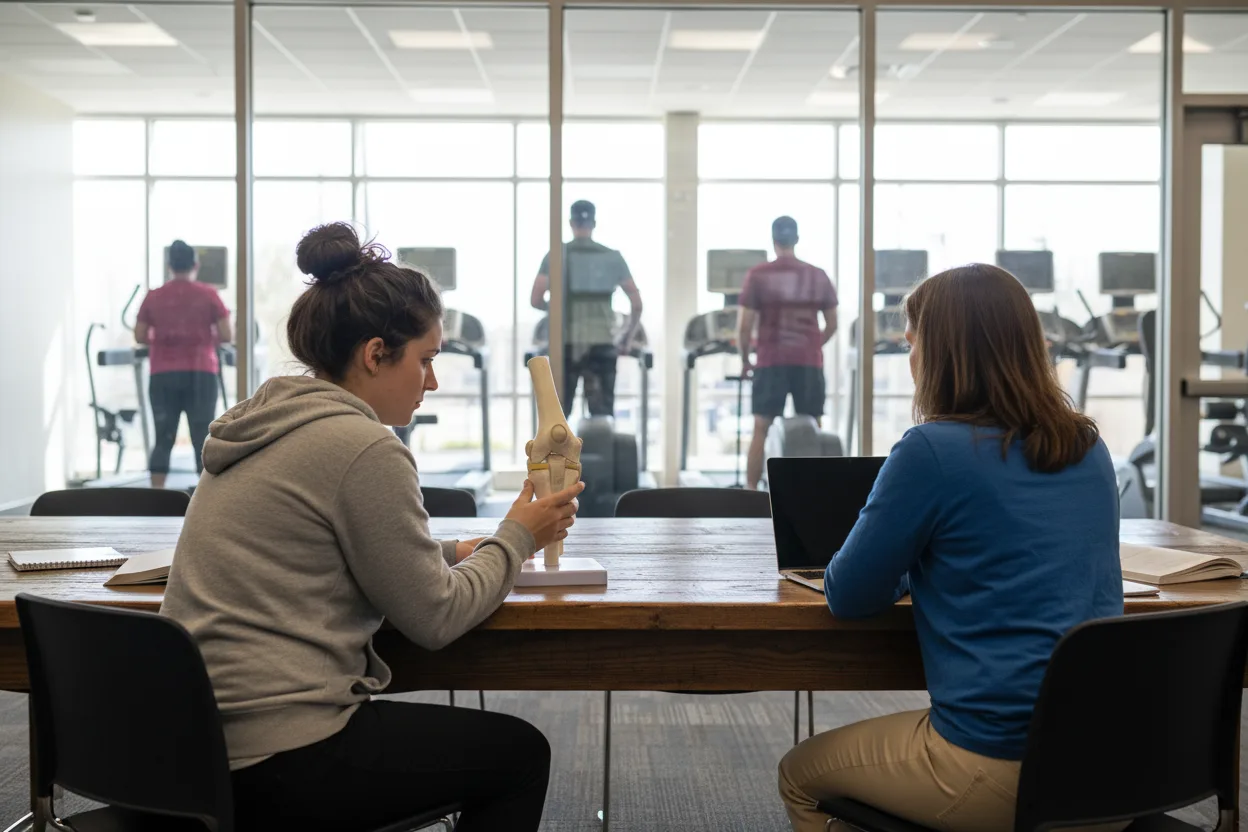
Exercise science vs kinesiology comes down to scope. Kinesiology is the broad study of human movement and physical activity. Exercise science is one part of it, focused on how the body responds to exercise. Schools use the two names loosely, so degrees with different labels can share most of their courses. Compare course lists and accreditation before you compare names.
What Is the Difference Between Exercise Science and Kinesiology?
Kinesiology is the umbrella. The American Kinesiology Association (AKA) defines it as an academic discipline that studies physical activity and its effect on health, society and quality of life. AKA says the field includes exercise science, sports management, athletic training, sport and exercise psychology, fitness leadership and physical education teacher education.
Exercise science is the part that looks at the body. You study how muscles, hearts and lungs respond to training, how to measure fitness, and how to build an exercise plan for a healthy client or one with a medical condition. Kinesiology adds questions about how people learn movement skills, why they stay active or don’t, and how sport shapes communities.
That’s the textbook split. Real diplomas don’t always follow it. The federal Classification of Instructional Programs (CIP) files both names under one entry, code 31.0505, titled Exercise Science and Kinesiology. Schools use CIP codes to report the degrees they award, so a degree in either name lands in the same bucket.
Exercise Science vs Kinesiology: Side by Side
The table shows how the two usually differ, using the online programs we track.
| Exercise Science | Kinesiology | |
|---|---|---|
| Scope | One focused area: how the body responds to exercise | The wider field of human movement, which includes exercise science |
| Core courses | Exercise physiology, biomechanics, exercise testing and prescription, strength training | The same core, plus motor learning, sport and exercise psychology, and sociocultural courses |
| Common tracks | Strength and conditioning, wellness, personal training, pre-health | Coaching, teacher education, sport management, health promotion, allied health |
| Common first jobs | Fitness trainer, wellness coordinator, exercise physiologist | The same jobs, plus coaching and youth sport |
| ACSM-EP today | Bachelor’s in exercise science accepted | Bachelor’s in kinesiology accepted |
| ACSM-EP from Aug. 15, 2027 | CAAHEP-accredited program, or one in the process | Same rule, so ask about the program’s accreditation |
| CSCS today | Any bachelor’s degree | Any bachelor’s degree |
| Online programs on our list | 46 (18 bachelor’s, 20 master’s) | 52 (18 bachelor’s, 27 master’s) |
| Median bachelor’s cost per credit | $398 across 17 programs | $445 across 15 programs |
The counts are ours. Of the 168 online programs we track, 52 sit in our kinesiology group and 46 in our exercise science group. At the master’s level kinesiology leads, 27 to 20. Browse them on our online kinesiology degree ranking and our online bachelor’s in exercise science ranking.
Price doesn’t split by name either. Seventeen online exercise science bachelor’s programs publish a per-credit rate, and the median is $398. Fifteen kinesiology programs do, and the median is $445. Exercise science runs from $220 to $650 per credit. Kinesiology runs from $380 to $727.67. The ranges overlap between $380 and $650.
Do Exercise Science and Kinesiology Classes Overlap?
Yes, and the overlap is bigger than the names suggest. Here are the same four subjects taught inside each label, from real online bachelor’s programs.
| Subject | In an Exercise Science Degree | In a Kinesiology Degree |
|---|---|---|
| Exercise physiology | HHP 363 Exercise Physiology I, University of Wisconsin-Superior | KIN 3305 Exercise Physiology, Texas Tech University |
| Biomechanics | EXS 351 Kinesiology/Biomechanics, Franklin University | KIN 321 Biomechanics of Human Movement, Oregon State University |
| Exercise testing | EXS 460 Exercise Testing and Prescription, Franklin University | SPMD 4350 Exercise Testing and Prescription, New Mexico State University |
| Motor learning | KES 3603 Motor Learning, University of the Southwest | KIN 366 Motor Learning, University of North Dakota |
Look at the exercise science column again. Franklin’s exercise science degree has a course called Kinesiology/Biomechanics, and the University of the Southwest’s has Kinesiology & Biomechanics. Abilene Christian’s online exercise science bachelor’s carries both EXSO and KINO course prefixes. Exercise science majors take kinesiology classes all the time.
Where the two pull apart is in the extras. Kinesiology programs add classes about people and sport. Oregon State’s online kinesiology bachelor’s includes Sociocultural Dimensions of Physical Activity (KIN 212) and Foundations of Sport and Exercise Psychology (KIN 270). North Dakota’s includes Adapted Physical Activity (KIN 404). Lewis-Clark State’s coaching emphasis has Advanced Coaching Theory (KIN-340) and Youth Sports and Recreation (KIN-352).
Exercise science leans clinical. Northeastern State’s degree lists Cardiopulmonary Rehabilitation and Exercise and Sport Pharmacology. Wisconsin-Superior’s includes Cardiovascular Diagnostics (HHP 460), and Franklin’s includes Exercise for Special Populations (EXS 400).
The pattern has exceptions. Texas Tech’s kinesiology degree has Applied Exercise Physiology (KIN 3306), and New Mexico State’s has its own Exercise for Special Populations (SPMD 4410).
Why Do Schools Name the Same Degree Differently?
Because each school names its own departments and degrees. Our list shows how loose the labels are:
-
New Mexico State’s Bachelor of Science in Kinesiology has a concentration in Applied Exercise Science.
-
Lewis-Clark State’s kinesiology degree comes in four emphases. One is called Exercise Science and Health Occupations.
-
The University of Florida’s master’s degree is titled Applied Physiology and Kinesiology.
-
Wisconsin-Superior’s Exercise Science, B.S. appears on the Universities of Wisconsin Online site as Physical Education with an Exercise Science concentration.
-
Northeastern State’s Health and Human Performance degree has an Exercise Science option, and the accreditor files it under exercise science.
So the diploma title tells you less than the course list and the accreditation. Two degrees named the same can differ more than two degrees with different names.
Which Jobs Can You Get With Each Degree?
Both degrees open the same first jobs. Pay follows the job. The table uses BLS wage data for May 2025.
| Job | U.S. Jobs | Median Pay | Range, 10th to 90th Percentile |
|---|---|---|---|
| Exercise physiologist | 8,560 | $59,460 | $42,760 to $80,560 |
| Exercise trainer or group fitness instructor | 322,930 | $47,160 | $28,800 to $83,100 |
| Coach or scout | 248,950 | $47,320 | $28,790 to $98,860 |
| Health education specialist | 65,690 | $64,070 | $42,990 to $118,200 |
The direct-title job, exercise physiologist, is small, with 8,560 positions nationwide. Personal training and coaching hire far more people at a lower median. Our kinesiology jobs guide sorts the rest by pay and requirements.
Kinesiology programs are more likely to build tracks around two jobs, coaching and teaching. Teaching needs a state license. North Dakota lists Teacher Education as its own stream inside the kinesiology degree. Concordia University Texas says its Coaching and Physical Education (EC-12) track is on campus only. A general online degree in either name usually won’t license you to teach.
Some careers sit behind graduate school no matter which name you choose. Physical therapists earn a median of $102,760 and need a Doctor of Physical Therapy degree. Athletic trainers earn $62,520 and need a professional master’s. Our comparisons of exercise science vs physical therapy and exercise science vs athletic training cover both.
Does the Degree Name Matter for the ACSM-EP and CSCS?
Less than the program’s accreditation does. Start with the ACSM Certified Exercise Physiologist (ACSM-EP). ACSM’s certification page asks for a minimum of a bachelor’s in exercise science, exercise physiology or kinesiology, so both names work today. ACSM also wants at least 21 semester hours of exercise science coursework, listed on its eligibility page.
That list includes exercise physiology, strength and conditioning, applied kinesiology or biomechanics, anatomy and physiology, exercise testing and prescription, special populations and health risk appraisal. A kinesiology degree that skips several of those may not meet the course requirement, however it’s named.
The bigger change lands on August 15, 2027. After that date, ACSM-EP candidates must graduate from a program accredited by CAAHEP (the Commission on Accreditation of Allied Health Education Programs), or one that has started the CAAHEP process. ACSM’s wording names exercise science and exercise physiology programs. It doesn’t name kinesiology.
That doesn’t lock kinesiology out. CAAHEP says its exercise science accreditation is meant for exercise science or related departments, with physical education and kinesiology named as examples. What counts is whether the program is on CAAHEP’s list, whatever the department calls it. If you’re looking at a kinesiology program, ask whether its exercise science track is accredited or in process.
On our list, one bachelor’s program is confirmed in CAAHEP’s directory: Northeastern State’s Bachelor of Science in Health and Human Performance. CAAHEP files it under exercise science, with initial accreditation dated March 18, 2022. Its name is neither exercise science nor kinesiology, which makes the point about labels. Our certification-ready ranking tracks every program with CAAHEP or CASCE accreditation.
Now the CSCS, the Certified Strength and Conditioning Specialist credential. NSCA’s prerequisites ask for a bachelor’s degree from an accredited school plus CPR/AED, and no particular major. From January 1, 2030, U.S. candidates need a bachelor’s from a program accredited by CASCE, NSCA’s program accreditation.
The accredited bachelor’s programs we’ve confirmed on NSCA’s CASCE list are the University of Missouri’s BS in Sport Science and Parker University’s BS in Strength and Human Performance. Texas A&M University-Corpus Christi’s MS in Kinesiology is CASCE accredited at the master’s level. Our guides to the ACSM exercise physiologist certification and the CSCS certification go deeper on both rules.
Which Degree Is Better for Physical Therapy School?
Neither, on the name alone. The American Physical Therapy Association says most DPT programs require a bachelor’s degree before admission. Each program sets its own prerequisite courses, and those lists decide whether your online degree fits.
Online programs handle this differently:
-
Franklin’s exercise science bachelor’s offers optional Pre-Medical, Pre-Physical Therapy and Pre-Occupational Therapy focus areas that add biology, chemistry and physics.
-
North Dakota’s kinesiology bachelor’s has an Allied Health stream for physical therapy, occupational therapy and chiropractic prerequisites.
-
Oregon State’s online kinesiology bachelor’s carries a note that it is not designed for students who want physical therapy, occupational therapy, athletic training, nursing, physician assistant or medicine.
Same field name, opposite advice. Labs are the other trap, because many DPT programs limit how much online lab credit they accept. Our pre-physical therapy ranking lists 40 online programs that say they serve that goal, and our pre-PT guide explains the prerequisites.
Which Online Programs Show the Difference?
These six programs show the range, from a narrow exercise science degree to a wide kinesiology one.
-
Franklin University, BS in Exercise Science. Online, 120 credits, $398 per credit, with courses in 6- and 12-week terms. You finish with either an on-site field experience (EXS 491) or a capstone (EXS 490).
-
Northeastern State University, BS in Health and Human Performance. Fully online and asynchronous at $279 per credit, with 120 credits. You choose Clinical Health and Wellness or Exercise Science, 21 hours each, and complete a practicum (P ED 4810).
-
Texas Tech University, BS in Kinesiology. Fully online in 8-week courses with several start dates. It offers an optional 200-hour capstone internship.
-
University of North Dakota, BS in Kinesiology. Four streams: Teacher Education, Coaching and Sports Management, Kinesiology Applications and Allied Health. It includes a 10-credit internship.
-
New Mexico State University, BS in Kinesiology. Applied Exercise Science concentration at $395.40 per credit, with an active military rate of $250 per credit.
-
University of Florida, MS in Applied Physiology and Kinesiology. Fully online, 30 credits at $585.75 per credit, with optional specializations that include sport and exercise physiology.
For master’s degrees, see our rankings of online master’s in exercise science and online master’s in kinesiology.
How Do You Choose Between the Two?
Work backward from what you want after the degree. Then check five things.
-
Name the job or graduate program. Fitness and wellness work fits either degree. Coaching and teaching lean kinesiology. A clinical path leans exercise science, and DPT and PA schools publish their own prerequisites.
-
Read the course list, not the title. Look for exercise physiology, biomechanics, exercise testing and prescription, and anatomy and physiology. Missing several of these matters more than the name.
-
Ask about accreditation. For the ACSM-EP after August 15, 2027, ask whether the program is CAAHEP accredited or in process. For the CSCS after January 1, 2030, ask whether it’s CASCE accredited.
-
Find the in-person piece. Ask who arranges the internship site, how many hours it takes, and whether you can do it near home.
-
Price the whole degree. Multiply the per-credit rate by the credits, then add fees. Published rates across the two names run from $220 to $727.67 per credit.
If two programs tie, take the one with the accreditation you need. A degree’s name won’t help you when an eligibility list is checked.
What Are the Downsides of Each Name?
Exercise science is narrower. If you later decide you want to coach or teach, you may find fewer tracks built for that. And only one bachelor’s program on our list is confirmed in CAAHEP’s directory. Plenty of schools say their courses prepare you for the ACSM-EP, but preparing you isn’t the same as being accredited.
Kinesiology is broad, so quality and focus vary the most. One school’s degree is built around teacher education, another’s around sport management, another’s around exercise testing. You have to read the track. The name also gets mixed up with Applied Kinesiology, an unrelated field that AKA says should be kept apart from the academic discipline.
And neither name promises a job. The exercise physiologist role has 8,560 positions nationwide, and the highest-paying paths behind these degrees need graduate school and a license.
How We Checked These Facts
We read the AKA, NCES, ACSM, CAAHEP, APTA and school pages on September 29, 2026. NSCA’s site blocks automated fetching, so we read its pages in a browser. Program details come from each school’s own pages, recorded in the program reviews linked above. Wage figures are BLS OEWS for May 2025.
The 46 and 52 program counts, the medians and the ranges come from our own program data, which stops at published online per-credit rates. Rules and fees change, so confirm with ACSM, NSCA and each school before you enroll. If a school page contradicts something here, tell us.
Frequently Asked Questions
Is Kinesiology the Same as Exercise Science?
Which Pays More, Exercise Science or Kinesiology?
Which Is Better for Physical Therapy School?
Can You Get the ACSM-EP With a Kinesiology Degree?
Do You Need an Exercise Science Degree for the CSCS?
Is Kinesiology the Same as Applied Kinesiology?
Can You Study Either Degree Online?
Sources
- About the American Kinesiology Association
- CIP Code 31.0505, Exercise Science and Kinesiology
- Exercise Physiologist Certification
- Updated ACSM-EP and ACSM-CEP Certification Eligibility Requirements
- Programmatic Accreditation
- Committee on Accreditation for the Exercise Sciences
- CSCS Exam Prerequisites
- Find a CASCE-Accredited Program
- Becoming a Physical Therapist
- Occupational Employment and Wage Statistics, May 2025
- Kinesiology (B.S.), Ecampus
- Kinesiology (B.S.)
All sources retrieved .