
To become a strength and conditioning coach, you finish a bachelor’s degree in exercise science, kinesiology or a related field, earn the Certified Strength and Conditioning Specialist (CSCS) credential, and log coaching hours through internships and assistantships. Some employers also ask for a master’s degree. The degree makes you eligible for the credentials, and the hours in a weight room build the rest of your résumé.
What Does a Strength and Conditioning Coach Do?
You plan the training and you coach it. A strength and conditioning coach writes programs that build strength, speed, power and endurance, teaches athletes to lift and move safely, and changes the plan when someone is worn down or hurt. O*NET’s task list for coaches includes directing physical conditioning programs, enforcing safety rules and demonstrating equipment such as weights.
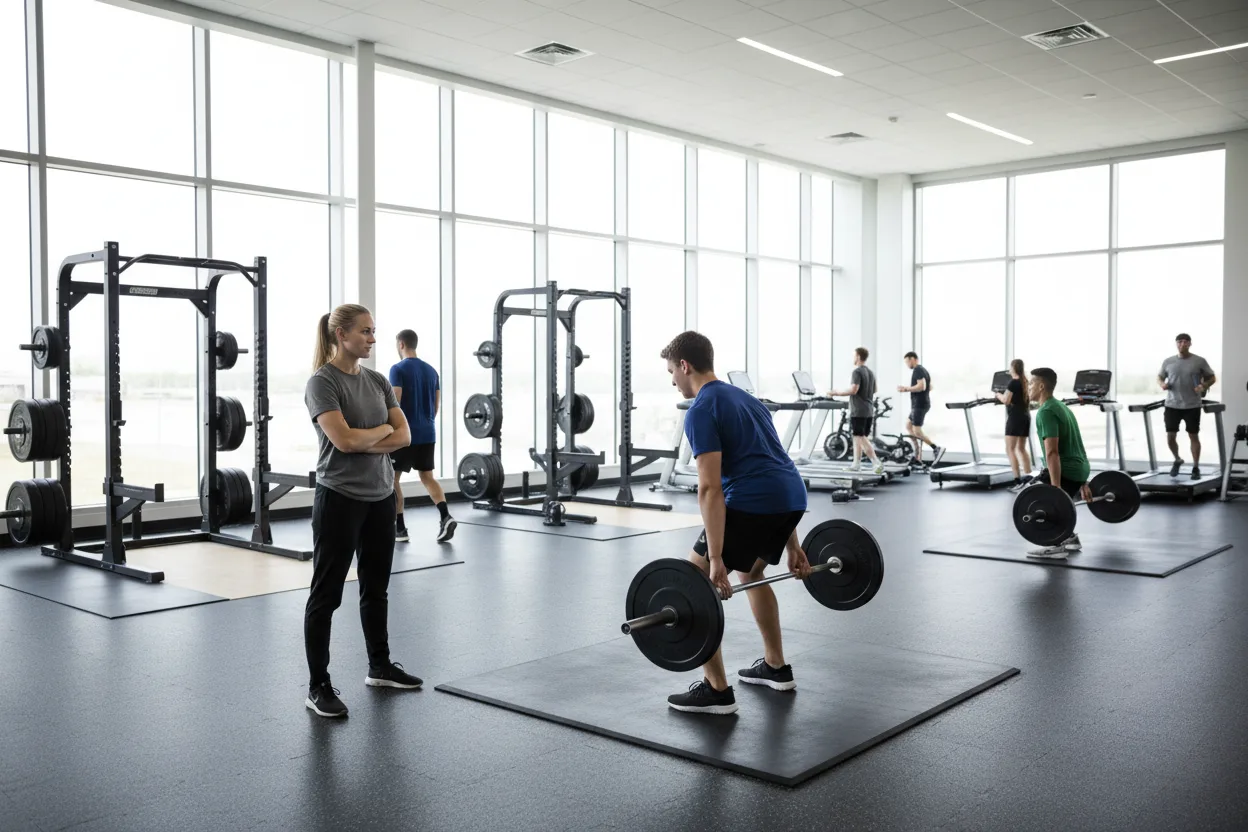
Picture a weekday in a college weight room. You arrive before the first team session, check the plan and set up racks and plates. You coach one group through squats and sprints, then another. In the afternoon you look at who’s been lifting slower than last week and rewrite the next block. Your schedule follows your athletes’ schedules, and it shifts with the season.
Strength and conditioning jobs exist at high schools, colleges, professional teams, private performance gyms and military units. What changes from one to the next is who you coach: teenagers still learning to squat, college athletes on a tight academic calendar, or adults whose paycheck depends on the sport.
How Do You Become a Strength and Conditioning Coach, Step by Step?
Here’s the sequence most people follow. The order can bend, and you’ll do steps two through four at the same time.
-
Pick a bachelor’s degree that leads to the credentials. Exercise science, kinesiology and sport science are common majors, and a few schools offer a bachelor’s named for strength and conditioning. Check whether the program is accredited by CASCE, the strength and conditioning accreditor NSCA now names, because that matters for the CSCS from 2030.
-
Start coaching before you graduate. Volunteer in your school’s weight room, take the internship course if your program has one, and go after a graduate assistantship if a master’s is in your plan.
-
Earn the CSCS. You can sit for it as a college senior. Our CSCS certification guide covers the exam, the fees and the 2030 rule in full.
-
Add the SCCC if college or pro teams are your target. It takes a 640-hour practicum under an approved mentor, so start early.
-
Decide about a master’s degree. It’s worth it when the jobs you want ask for one, and when a graduate assistantship pays part of the way.
-
Apply, and keep logging hours. Your first title may be intern, assistant or graduate assistant.
Plan on four years for a bachelor’s degree if you’re starting from zero. Transfer credit shortens that. The Citadel’s sample map for its online completion degree covers 60 credits in two years for a student whose general education is already finished, and a full-time master’s at University of Wisconsin-River Falls takes 12 to 16 months.
What Are the Strength Coach Requirements for Education?
Start with what employers say. O*NET asked working coaches and scouts what a new hire needs. Forty-nine percent said a bachelor’s degree, 19% said a master’s and 17% said an associate degree. That’s for the whole coaching group, not only strength coaches, but it shows where the middle sits: a bachelor’s.
Then look at the credentials, because they set the hard floor. NSCA’s CSCS needs a bachelor’s degree from an accredited institution, or college senior status, plus current CPR/AED. It names no required major today. The CSCCa’s SCCC needs a completed bachelor’s and proof of four courses of at least three credits each: anatomy and physiology, exercise physiology, biomechanics or kinesiology, and nutrition.
CSCCa also says a bachelor’s in exercise science or kinesiology from a CAAHEP or CASCE accredited institution meets that course rule without the list. CAAHEP is the Commission on Accreditation of Allied Health Education Programs, the accreditor for exercise science degrees.
The rule to watch is January 1, 2030. From that date, U.S. candidates for the CSCS need a bachelor’s degree from a CASCE-accredited program. If you’re still choosing a school, treat CASCE as a filter. Our accreditation guide explains how CASCE differs from CAAHEP.
Which Certifications Do Strength and Conditioning Coaches Earn?
Two credentials matter most for coaches who work with athletes, and they aren’t interchangeable.
| CSCS | SCCC | |
|---|---|---|
| Issued by | NSCA | CSCCa |
| Built for | Coaches of athletes and teams in any setting | Full-time college and professional coaches |
| Degree | Bachelor’s, or college senior status | Completed bachelor’s, plus four science courses |
| Hands-on hours | None required | 640-hour practicum under an approved mentor |
| Exam | Two written sections | Written exam plus a practical exam before a panel |
| Fee | $340 for members, $475 for non-members | $340 for members, $470 for non-members |
The pass rates tell you how hard each one is, though they’re measured differently. NSCA reports that 41% of 2024 CSCS candidates passed both sections. CSCCa’s 2025 table shows 100 candidates and a 69% overall pass rate for the SCCC.
CSCCa also says legislation that took effect August 1, 2015 requires full-time Division I strength and conditioning coaches to hold a certification accredited by the NCCA, the National Commission for Certifying Agencies. NSCA and CSCCa each say their certification carries that accreditation.
Two more credentials come up. The National High School Strength Coaches Association offers the HSSCC, written for the high school setting and taken online. And a personal trainer certification, such as the NSCA-CPT, needs no degree, which makes it a useful first credential while you finish one. It doesn’t replace the CSCS in a team job posting. Our CSCS exam guide breaks down what the test asks.
Can You Get a Strength and Conditioning Degree Online?
Yes. Our online strength and conditioning degree ranking lists 54 programs: 39 master’s, 12 bachelor’s, 2 doctorates and 1 associate degree. Forty of them say their courses prepare you for the CSCS.
But the coursework is only half of the job. Strength coaching happens next to a barbell, so the programs worth a close look put you in a weight room at least once. Here’s how nine of them handle it.
| Program | Level | Credits | Cost per credit | Hands-on piece |
|---|---|---|---|---|
| University of Missouri BS in Sport Science, Strength and Conditioning | Bachelor’s | 120 | $707.50 in state, $841.70 out of state | 3 to 6 credit internship, no campus visits |
| Parker University BS in Strength and Human Performance | Bachelor’s | 120 | $777 | 80-hour practicum, or a 300-hour in-person internship |
| The Citadel BS in Strength and Conditioning, Degree Completion | Bachelor’s | 122 | $520 | 3-credit field experience and a 6-credit internship |
| Florida Atlantic University BS in Exercise Science and Health Promotion | Bachelor’s | 120 | $203.29 in state, $799.72 out of state | Internship with two distinct athletic populations |
| University of Wisconsin-River Falls MS in Strength and Conditioning | Master’s | 33 | $540 | Three in-person weekends, 6-credit internship |
| Logan University MS in Strength and Conditioning | Master’s | 42 | $700 | Two 150-hour field experiences |
| Southern Utah University MS in Sports Conditioning and Performance | Master’s | 33 | $393 | Two-week summer session on campus |
| Concordia University-Saint Paul MS in Strength and Conditioning | Master’s | 33 | $475 | None; no clinical placement |
| University of Florida MS in Applied Physiology and Kinesiology | Master’s | 30 | $585.75 | Optional internships |
Two of the bachelor’s programs hold NSCA’s CASCE accreditation: Missouri and Parker. Only those two bachelor’s programs on our list are confirmed on the CASCE list. The rest may still work for you if you’ll sit for the CSCS before 2030, but ask the admissions office where they stand.
Cost depends on your starting point. Missouri’s own estimate is $84,900 for a student starting from zero and $42,450 for a typical transfer student with 60 credits left, both at $707.50 per credit. The Citadel requires at least 30 prior college credits, and 60 credits at $520 comes to $31,200 before fees.
For a master’s, the spread is wide. Southern Utah’s 33 credits at $393 come to $12,969 in tuition, while Logan’s 42 credits at $700 come to $29,400. You’ll find more options on our list for coaches and for former or current athletes.
If you’re weighing a program that names the CSCS, our certification-ready ranking shows which ones hold CAAHEP or CASCE accreditation.
Where Do You Find Strength and Conditioning Jobs?
Search the places coaches actually post. NSCA runs a career site for strength and conditioning jobs. CSCCa runs a jobs board with categories for full-time, part-time, graduate assistant and internship postings. NHSSCA has its own jobs board for high school coaches.
Look at those categories. They tell you how people start: as interns and graduate assistants, then as part-time and full-time staff. CSCCa says graduate and undergraduate assistantships can count toward the SCCC practicum, so one position can cover your hours and your degree at once.
The practicum rules are specific. You need at least 640 hours under a CSCCa-approved mentor. CSCCa gives 20 hours a week over 8 to 9 months as a common timeline. A $230 practicum fee goes to CSCCa, and you file a waiver form before you start. The hours must finish within three years of your first exam date.
Private facilities count too. University of Wisconsin-River Falls describes its 6-credit internship as NCAA strength and conditioning positions or private training centers. If your internship search has to start near home, a private gym is a reasonable place to look.
How Much Do Strength and Conditioning Coaches Make?
BLS doesn’t publish a wage row for strength and conditioning coaches by name. The closest fit is Coaches and Scouts, which mixes every sport and level. Treat these BLS OEWS numbers from May 2025 as a rough guide, not a quote for your first job.
| Percentile | Coaches and Scouts | Exercise Trainers and Group Fitness Instructors |
|---|---|---|
| 10th | $28,790 | $28,800 |
| 25th | $35,330 | $35,280 |
| Median | $47,320 | $47,160 |
| 75th | $64,710 | $61,730 |
| 90th | $98,860 | $83,100 |
About 248,950 people were employed as coaches and scouts. The mean, which top earners pull upward, was $60,160. Louisiana ($86,520), the District of Columbia ($83,290) and New Jersey ($81,840) had the highest mean pay, while California (31,150 jobs), Florida (18,120) and Texas (15,300) employed the most.
The second column matters if you start in a gym. Exercise trainers and group fitness instructors are the usual entry job for people without a team position yet. Our strength and conditioning coach salary page covers pay by state and setting, and what the BLS category leaves out.
The outlook is decent, but it’s not specific. O*NET projects growth of 5% to 6% for Coaches and Scouts from 2024 to 2034 and 41,800 openings. No one can promise you a position from a projection, and that figure doesn’t isolate weight-room jobs.
What Are the Downsides of Strength Coaching as a Career?
It’s a good career for the right person, and it comes with real costs. Go in knowing them.
Your first role may not look like the median. The broad coaching category has a median of $47,320, and the bottom tenth earns $28,790 or less. Internships and graduate assistantships are two of the four categories on CSCCa’s job board, so don’t assume the median describes your first year.
The SCCC costs time and money. A 640-hour practicum, a $230 practicum fee and an exam fee of $340 or more all come before the SCCC is in hand.
Online has limits. You can learn program design from home. You can’t learn to coach a squat without someone squatting in front of you. Choose a program that builds in a field experience, and ask who arranges the site. The Citadel’s page doesn’t say, and that’s a question to send them.
The 2030 rule adds a deadline. A bachelor’s degree from a non-CASCE program stops qualifying for the CSCS for U.S. candidates on January 1, 2030, and the confirmed online bachelor’s list is short.
Your schedule follows the athletes. Early lifts, evening sessions and travel come with a team job. Ask current coaches what their week looks like before you commit years to it.
Which Route Fits Your Starting Point?
| If you’re | Next step | Where to look |
|---|---|---|
| Starting college | Choose a bachelor’s, and put CASCE first if the CSCS matters | Certification-ready degrees |
| Holding some college credit | Finish with a degree completion program | Degree completion programs |
| Holding a bachelor’s in another field | Look at master’s programs that accept it | Strength and conditioning degrees |
| Coaching a team already | Pair the degree with the job you have | Degrees for coaches |
| A current or former athlete | Turn your training background into a credential | Degrees for athletes |
If your bachelor’s isn’t in exercise science, University of Florida’s master’s accepts any major, and Logan accepts non-science bachelor’s degrees when you’ve finished its prerequisites. Southern Utah takes a bachelor’s plus a fitness certification such as the CSCS or NSCA-CPT. And if you want the wider picture of where an exercise science degree leads, our exercise science jobs guide covers the other careers.
How We Checked These Facts
We read the CSCCa pages, including exam requirements, the practicum rules, pass rates and the jobs board, on September 29, 2026. Wages are BLS OEWS May 2025 as stored in our data, and outlook figures are from O*NET OnLine. NSCA requirements come from our CSCS guide, which we verified against NSCA’s own pages. Program details come from each school’s own pages, recorded in the program reviews linked above.
Requirements, dates and fees can change. Check NSCA’s CSCS page and CSCCa’s certification pages before you register or enroll. If a school page says something that contradicts this guide, tell us.
Frequently Asked Questions
Do You Need a Degree to Be a Strength and Conditioning Coach?
What Is the Best Degree for a Strength and Conditioning Coach?
Is the CSCS Required to Be a Strength Coach?
How Long Does It Take to Become a Strength and Conditioning Coach?
Can You Become a Strength and Conditioning Coach With an Online Degree?
What Is the Difference Between the CSCS and the SCCC?
How Much Do Strength and Conditioning Coaches Make?
Sources
- CSCS Certification
- CSCS Exam Prerequisites
- Find a CASCE-Accredited Program
- SCCC Certification
- SCCC Certification Exam Requirements
- Practicum and Internship Requirements
- Coaches and Scouts, 27-2022.00
- Occupational Employment and Wage Statistics, Coaches and Scouts
- High School Strength Coach Certification (HSSCC)
- Strength and Conditioning, B.S. Degree Completion
All sources retrieved .