
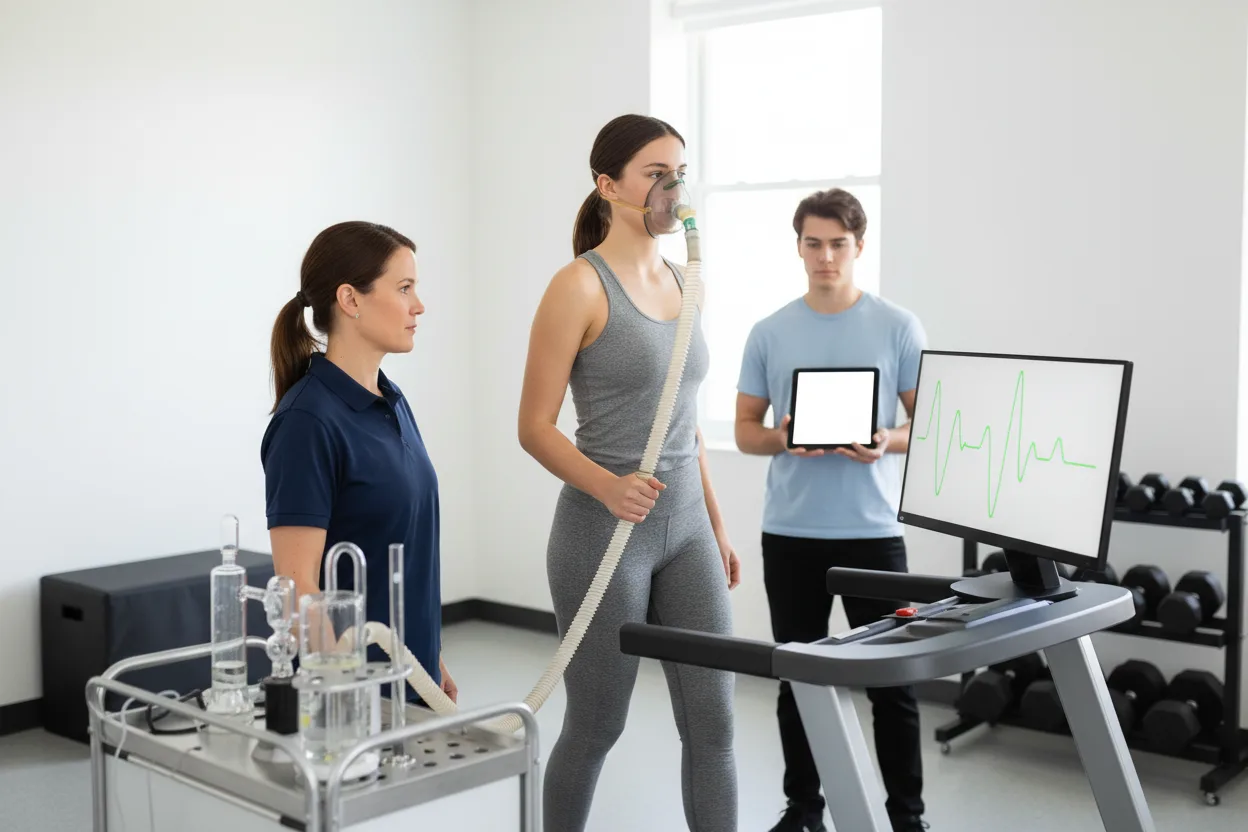
Exercise science is the study of how the human body responds and adapts to movement, exercise and physical activity. An exercise science degree teaches you that science through courses in exercise physiology, biomechanics and nutrition, then points you toward fitness, clinical exercise, coaching or graduate school. You can earn one online at every level, from associate to doctorate, though some programs add an in-person internship.
What Is Exercise Science, Exactly?
Start with the definition schools actually use. James Madison University’s kinesiology department describes exercise science as a discipline that studies movement and the functional responses and adaptations that come with it. Its stated goal is to connect fitness, exercise, diet and health.
Put plainly, it’s the science of what exercise does to your heart, muscles and metabolism, and how to use that knowledge to help someone.
JMU lists the parts that make up the field: biomechanics, sports nutrition, sport and exercise psychology, motor control and development, and exercise physiology. Coursework also teaches you to evaluate health behaviors and risk factors, run fitness assessments and write exercise prescriptions.
A few terms will come up all through this guide:
- Exercise physiology is how the body reacts to a workout, in the short term and after months of training.
- Biomechanics is how forces and movement work in the body, like what your knee does when you land from a jump.
- Exercise prescription is a written plan with specific activities, intensities and progressions, built from a person’s test results and health.
JMU also notes that exercise science professionals work on multidisciplinary teams. The range runs from helping people recover from the effects of a sedentary lifestyle to helping athletes perform at their maximum.
What Is an Exercise Science Degree?
An exercise science degree is a college program in that field, and it comes at four levels. The bachelor’s is the standard one, at 120 credits in most of the programs we track. Here’s how the four look across the 168 online programs on our list.
| Level | Programs | Median cost per credit | Median total tuition |
|---|---|---|---|
| Associate | 11 | $239 | $15,000 |
| Bachelor’s | 46 | $445 | $54,240 |
| Master’s | 99 | $610 | $20,200 |
| Doctorate | 12 | $690 | $41,745 |
The master’s median total is lower than the bachelor’s because a master’s is about 30 credits, not 120.
Associate degrees are about 60 credits and mostly work as a first two years. Georgia State’s fully online Exercise Science Pathway charges a flat $105 per credit, so 60 credits comes to $6,300. Read the fine print, though. It’s an advising pathway, not a major printed on your diploma.
Bachelor’s degrees are where most people start. Franklin University’s B.S. is 120 credits at $398 each, in six-week terms with eight start dates a year. At the low end, the University of the Cumberlands charges $220 per credit, and it says the rate includes books and fees. That’s 120 credits times $220, or $26,400 (its online program).
Master’s degrees go deeper into a specialty like clinical exercise physiology, strength and conditioning or research. Forty-four of our 99 master’s programs don’t require the GRE. The University of Cincinnati’s fully online M.S. is 30 credits at $761 each, with no GRE and an applied experience capstone.
Doctorates are for research and university teaching. Concordia University Chicago’s online PhD is 69 credits at $775 each, which is 69 times $775, or $53,475, and it ends with a 9-credit dissertation. It expects a master’s degree first.
Notice the names, too. The same field goes by several labels. Our list has 46 programs filed under exercise science, 52 under kinesiology, 12 under human performance and 10 under sport science. Northeastern State’s degree is called Health and Human Performance, and CAAHEP lists it as an exercise science program.
What Do You Study in an Exercise Science Major?
You study the body first and the gym second. The bachelor’s programs we’ve reviewed put anatomy and physiology up front, then build toward exercise physiology, biomechanics, fitness testing and prescription. Here’s how the pieces show up as real course titles.
| Area | What you learn | Course titles from programs on our list |
|---|---|---|
| Anatomy and physiology | How the body is built and how it works | Functional Human Anatomy and Physiology (Cumberlands); Functional Anatomy (Concordia-Saint Paul) |
| Exercise physiology | How the body reacts to exercise | EXS 252 Exercise Physiology (Franklin); Physiology of Exercise (Northeastern State) |
| Biomechanics | Forces, joints and movement | EXS 351 Kinesiology/Biomechanics (Franklin) |
| Testing and prescription | Measuring fitness, then writing the plan | EXS 460 Exercise Testing and Prescription (Franklin); Advanced Fitness Assessment (Northeastern State) |
| Nutrition and behavior | Fueling, habits and motivation | Applied Nutrition (Concordia-Saint Paul); Behavior Change for Lifestyle Wellness (Cumberlands) |
| Special populations | Older adults, heart and lung patients | EXS 400 Exercise for Special Populations (Franklin); Cardiopulmonary Rehabilitation (Northeastern State) |
| Strength and conditioning | Training athletes and general clients | EX 375 Concepts of Strength Training and Conditioning (University of Saint Mary) |
Most programs finish with an applied piece. Franklin students complete a four-credit field experience at a healthcare facility, fitness center or community rec center, or a four-credit capstone instead. Saint Mary requires a three-credit internship, and its online degree completion program lets you transfer up to 90 credits. Our exercise science courses guide goes through more titles.
What Do Exercise Scientists Do for Work?
Exercise scientists test, plan and coach. In ACSM’s words, its certified exercise physiologists conduct and interpret fitness assessments and develop exercise prescriptions for people who are healthy or have medically controlled diseases. O*NET describes the same occupation as assessing, planning or implementing fitness programs that improve heart and lung function, strength, endurance and flexibility.
JMU names the settings: college sport teams, athletic performance centers, fitness and wellness centers, hospital fitness and rehabilitation centers, university and industry research labs, and weight control programs.
Now the numbers. These are national medians from the BLS Occupational Employment and Wage Statistics for May 2025. Half of the workers in each job earn less than the median, so read the range column too.
| Job | Jobs nationwide | Median pay | Middle 80% earn | Usual entry |
|---|---|---|---|---|
| Exercise physiologists | 8,560 | $59,460 | $42,760 to $80,560 | Bachelor’s |
| Exercise trainers and group fitness instructors | 322,930 | $47,160 | $28,800 to $83,100 | No degree required |
| Coaches and scouts | 248,950 | $47,320 | $28,790 to $98,860 | Bachelor’s |
| Recreational therapists | 14,930 | $61,960 | $40,990 to $100,420 | Bachelor’s |
| Health education specialists | 65,690 | $64,070 | $42,990 to $118,200 | Bachelor’s |
| Athletic trainers | 30,500 | $62,520 | $48,180 to $88,760 | Master’s |
| Physical therapists | 267,330 | $102,760 | $77,140 to $135,140 | Doctorate |
| Physician assistants | 162,150 | $135,880 | $99,380 to $190,280 | Master’s |
Look at the first row. Exercise physiologist is the job that matches the degree name, and it’s a small occupation. O*NET projects much faster than average growth from 2024 to 2034, with about 1,700 openings, but 8,560 jobs nationwide means you won’t find one on every corner.
Personal training is the volume job, and you don’t need a degree for it. You need a certification such as the ACSM-CPT or NSCA-CPT. The degree helps with the ceiling, since the top 10% of trainers earn $83,100 or more, and with moving into management or special populations.
Two credentials do look at your degree. The ACSM Certified Exercise Physiologist (ACSM-EP) asks for a bachelor’s in exercise science, exercise physiology or kinesiology plus adult CPR/AED, and the exam costs $460, or $350 for ACSM members. The Certified Strength and Conditioning Specialist (CSCS) asks for a bachelor’s today. Read our CSCS guide and ACSM exercise physiologist guide before you pick a program.
For a fuller job list with pay, see exercise science jobs and the exercise physiologist career guide.
How Does Exercise Science Differ From Kinesiology, Athletic Training and Physical Therapy?
These four get mixed up constantly, and the differences change what you enroll in.
Kinesiology is the broader study of human movement. Exercise science is the part aimed at exercise and the body’s response to it. JMU houses its exercise science concentration inside its kinesiology department, and ACSM accepts a bachelor’s in either field for the ACSM-EP. Our exercise science vs kinesiology guide sorts out which label to look for.
Athletic training is a separate profession. An athletic trainer needs a professional master’s from an accredited athletic training program, then BOC certification. An exercise science bachelor’s alone doesn’t qualify you. Our exercise science vs athletic training guide explains the split.
Physical therapy is a doctoral profession with a license. Exercise science is a common major for people heading to a DPT, and the pay gap is large: $102,760 median for physical therapists against $59,460 for exercise physiologists. If that’s your plan, start with our pre-physical therapy exercise science ranking.
Can You Study Exercise Science Online?
Yes, and you have more choices than most fields. Of the 168 programs on our list, 133 are fully online, 29 are online with onsite requirements and 6 are degree completion programs. That’s 133 of 168, or 79.2%, with no campus visit at all.
What moves online is the lecture, reading, discussion and testing. What doesn’t always move is the hands-on part, and it’s worth knowing which programs send you somewhere in person:
- Franklin University lets you do its field experience at an organization you choose. Availability varies by state, and some states only work through employer partnerships.
- Concordia University-Saint Paul’s B.A. requires its internship at an approved local site such as a gym, wellness program or rehab facility.
- Lebanon Valley College’s clinical exercise physiology master’s requires three residency weekends in Annville, Pennsylvania, and a 600-hour clinical internship.
- Northeastern State’s bachelor’s requires a practicum, and its published pages don’t say how online students arrange one. Ask before you apply.
Timing is another draw. Franklin’s school calculator estimates about 20 months for a student who arrives with an average of 67 transfer credits. If you already have credits, our degree completion ranking is the place to start. Our worth-it guide covers labs and internships in more depth.
Why Does Accreditation Matter for an Exercise Science Degree?
Two kinds of accreditation apply, and most students only hear about one. The first is the school’s own, which decides whether credits transfer and whether you can use financial aid. The second is programmatic, meaning the exercise science program itself is reviewed.
For exercise science, the programmatic reviewer is CAAHEP, working through its Committee on Accreditation for the Exercise Sciences. The committee was set up in April 2004 and reviews exercise science, exercise physiology and personal fitness training programs.
That used to be a nice-to-have. It’s becoming a gate. ACSM’s rule says that from August 15, 2027, ACSM-EP and ACSM-CEP candidates must graduate from a CAAHEP-accredited exercise science or exercise physiology program, or one that has started the CAAHEP process. The NSCA says that from January 1, 2030, U.S. candidates for the CSCS need a bachelor’s from a CASCE-accredited program.
Here’s how the supply looks on our list. Four programs are confirmed on both CAAHEP’s list and the school’s own pages, and just one of them is a bachelor’s. That one is Northeastern State’s Health and Human Performance B.S., which CAAHEP lists under exercise science with initial accreditation granted in March 2022.
Five programs are confirmed on both the CASCE list and the school’s pages, and two of them are bachelor’s degrees. If you want either credential, sort by accreditation first. Our certification-ready ranking does that, and the accreditation guide explains both rules.
Is Exercise Science Hard?
It’s a science degree, so yes, it’s harder than its gym-friendly reputation suggests. You won’t spend four years lifting weights and writing workout plans.
Look at what programs ask for. Franklin’s optional pre-medical, pre-physical therapy and pre-occupational therapy focus areas add biology, chemistry and physics. Liberty University’s online master’s expects prior physiology or exercise physiology, biomechanics or physics, and statistics. If you haven’t had them, you’d start with its Foundations of Human Performance course first.
Statistics and research methods also show up. Cincinnati’s master’s lists Research Methods and Analysis in Exercise and Sport Science, and Concordia Chicago’s PhD adds several statistics and research design courses.
Online adds its own kind of difficulty. Asynchronous courses give you flexibility, but nobody is standing next to you when you fall behind. Plan your weekly study hours before you enroll.
What Are the Downsides of an Exercise Science Degree?
It’s a good degree for the right goal, and a weak one for the wrong goal. Four things to know first.
The direct job is small and modest. BLS counts 8,560 exercise physiologists, with a median wage of $59,460. Most exercise science graduates end up in adjacent jobs, and some of those pay less.
The best-paying paths need more school. Physical therapy, occupational therapy and physician assistant work all require graduate degrees. So does athletic training. A bachelor’s is the first step, not the finish line.
Prerequisites can trip up online students. If you’re aiming at a DPT, PA or chiropractic program, look up the required lab sciences and whether the program accepts online lab credit before you choose a bachelor’s.
Accreditation is thin. Only one bachelor’s on our list is confirmed on both CAAHEP’s list and the school’s pages, and the 2027 and 2030 rules make that a real limit if you need a certification.
None of this means skip it. It means choose the degree for a target job, not for the title.
Who Should Choose an Exercise Science Major?
It fits you if you like physiology and want to apply it, you’re already working as a trainer or coach and want the science behind it, or you’re a healthcare worker moving toward exercise and rehabilitation. It also fits someone building toward a health professional program who’s ready to handle the science prerequisites.
It fits less well if you want to be an athletic trainer or physical therapist tomorrow, or if you want a high income without graduate school.
Here’s the order we’d work in:
- Name the job you want, and check whether it needs a degree, a certification or graduate school.
- Check accreditation against the 2027 and 2030 rules if a credential is in your plan.
- Read what the program requires in person, and who arranges the site.
- Compare cost per credit, transfer limits and start dates.
Then browse the best online exercise science degrees, or go straight to the bachelor’s ranking or the master’s ranking. For cost, our degree cost guide works through the math.
How We Checked These Facts
We took the definition and settings from James Madison University’s exercise science page and the accreditation rules from ACSM’s, NSCA’s and CAAHEP’s own pages, all read on September 29, 2026. Wages are BLS Occupational Employment and Wage Statistics for May 2025, and growth and openings are O*NET projections for 2024 to 2034.
Program details come from each school’s own pages, verified on September 29, 2026. Schools change prices and requirements, so confirm on the program page before you apply. And if a school page says something different from what we’ve written, tell us.
Frequently Asked Questions
What Is Exercise Science in Simple Terms?
What Can You Do With an Exercise Science Degree?
Is Exercise Science a Hard Major?
What Is the Highest Paying Job in Exercise Science?
Can You Get an Exercise Science Degree Online?
Can You Become a Physical Therapist With an Exercise Science Degree?
Is Exercise Science the Same as Kinesiology?
Do You Need a Degree to Work in Exercise Science?
Sources
- What Is Exercise Science?
- Committee on Accreditation for the Exercise Sciences
- Exercise Physiologist Certification
- Programmatic Accreditation
- CSCS Certification
- Exercise Physiologists (29-1128.00)
- Occupational Employment and Wage Statistics, May 2025
- B.S. in Exercise Science
- Health and Human Performance, B.S.
- Kinesiology and Health, Exercise Science Pathway (A.S.)
All sources retrieved .