

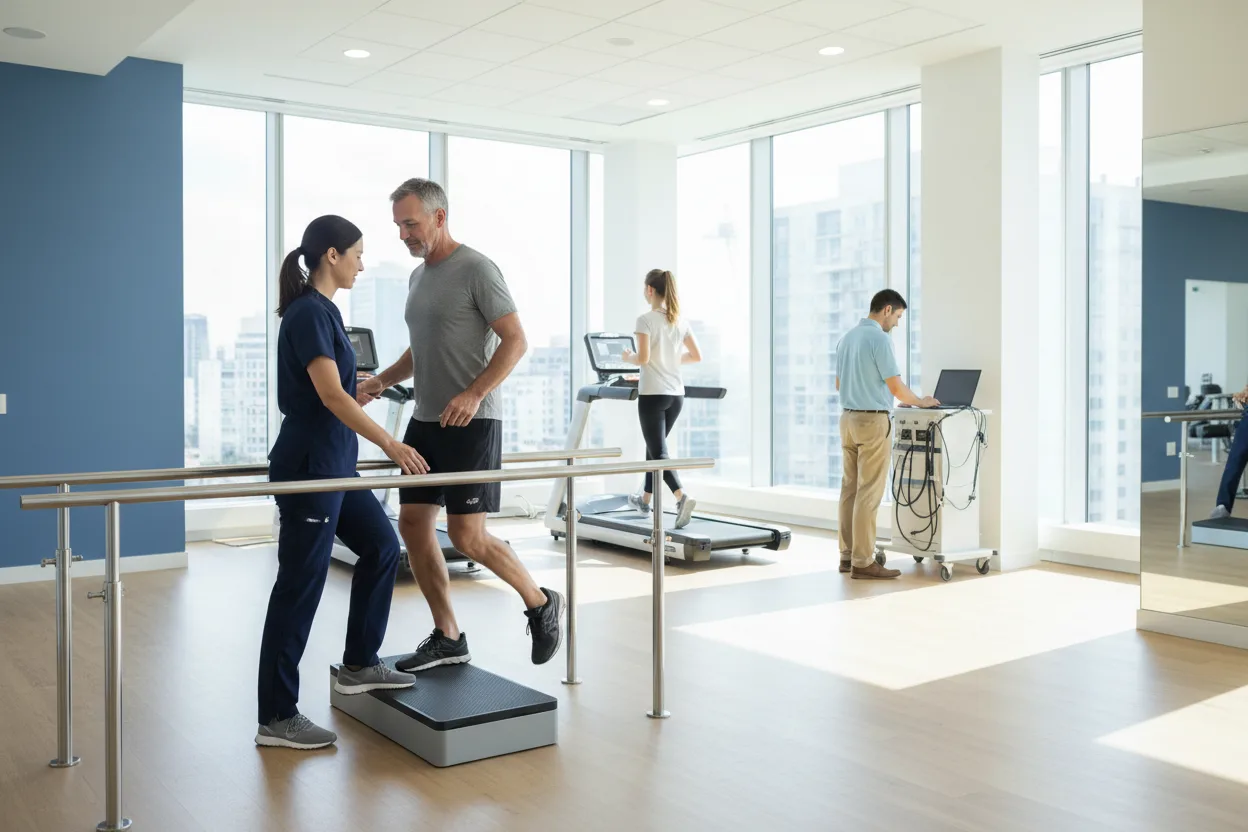
Exercise science vs physical therapy is really a bachelor’s degree versus a doctorate. Exercise science is a four-year degree that leads to jobs like exercise physiologist. Physical therapy is a licensed profession that requires a Doctor of Physical Therapy (DPT), which takes about three more years after a bachelor’s. Plenty of people study exercise science first, then apply to DPT programs.
What Is the Difference Between Exercise Science and Physical Therapy?
They sit at different points on the same road, so comparing them directly can feel odd. Exercise science is the study of how the body responds to movement: muscle, heart, lungs, energy use, training. Physical therapy is the job of evaluating and treating people whose movement is limited by injury, surgery, disease or age.
You can get an exercise science degree and never touch a patient in a clinic. You can’t practice physical therapy without one specific graduate degree. The American Physical Therapy Association (APTA) says the required degree is a DPT from a program accredited by the Commission on Accreditation in Physical Therapy Education (CAPTE), and that you also have to pass a state licensure exam.
That’s why the real question is usually “do I want the bachelor’s job, or do I want the DPT?” Both are legitimate. They just ask very different things of you.
Exercise Physiologist vs Physical Therapist: Side by Side
Most people asking about exercise science are picturing the job it maps to most directly, the exercise physiologist. So here’s that job next to the physical therapist.
| Exercise Physiologist | Physical Therapist | |
|---|---|---|
| Typical entry education | Bachelor’s degree | DPT, usually after a bachelor’s |
| Accreditor that matters | CAAHEP (for the ACSM credentials from 2027) | CAPTE (for the DPT) |
| Legal gate | Optional credential such as the ACSM-EP | State license |
| Time after high school | About 4 years | About 7 years (4 plus a typical 3) |
| Employment (BLS, May 2025) | 8,560 | 267,330 |
| Median pay | $59,460 | $102,760 |
| Projected openings, 2024 to 2034 | 1,700 | 13,200 |
Now the daily work. O*NET’s task list for exercise physiologists includes conducting stress tests with electrocardiograph machines, measuring oxygen consumption with spirometers, and prescribing individualized exercise programs. The American College of Sports Medicine (ACSM) describes its certified exercise physiologists as people who conduct fitness assessments and develop exercise prescriptions for people who are healthy or have medically controlled diseases.
O*NET’s list for physical therapists starts differently: perform an initial exam, evaluate the data to determine a diagnosis before treatment, and carry out treatment programs to restore function or relieve pain.
That’s the line. An exercise physiologist tests and prescribes exercise. A physical therapist evaluates, diagnoses and treats. In a cardiac rehab gym the two can stand ten feet apart, but they don’t hold the same license.
Our guide to how to become an exercise physiologist covers that career in full.
How Much Do Physical Therapists and Exercise Physiologists Make?
Physical therapists make about $43,300 more at the median. The arithmetic: $102,760 minus $59,460 equals $43,300. These are national medians from the BLS Occupational Employment and Wage Statistics survey, May 2025.
Here’s the fuller picture, including the assistant role we’ll come back to.
| Job | Employment | Median | 10th to 90th Percentile |
|---|---|---|---|
| Physical therapist | 267,330 | $102,760 | $77,140 to $135,140 |
| Physical therapist assistant | 112,430 | $68,380 | $47,750 to $89,510 |
| Exercise physiologist | 8,560 | $59,460 | $42,760 to $80,560 |
| Exercise trainer or group fitness instructor | 322,930 | $47,160 | $28,800 to $83,100 |
Look at the overlap. The physical therapists at the bottom tenth earn $77,140, which is more than the exercise physiologist median and close to the top tenth of exercise physiologists at $80,560. So the gap isn’t a few edge cases. It runs the whole distribution.
And keep the head counts in mind. There are 8,560 exercise physiologists in the BLS count and 267,330 physical therapists. Exercise physiologist is a small title, and many exercise science graduates end up in trainer, coaching or health education jobs instead. Our exercise science jobs guide covers those.
These are medians, not promises. Your pay depends on your state, your setting and your experience. Nothing here guarantees a job or a salary.
What Does Each Path Cost in Time and Tuition?
Time first. An exercise science bachelor’s is 120 credits at most of the programs we list, so about four years full time, less if you transfer credits. A DPT adds what APTA calls typically three years. Some schools run a “3+3” format, where three years of pre-PT courses lead straight into a three-year DPT.
Now tuition. We can speak to the bachelor’s side because we track it. Across the 42 online bachelor’s programs on our list with a published per-credit rate, the cost runs from $220 to $845.68 per credit, and the median is $445. The median total tuition for an online bachelor’s is $54,240.
We don’t rank DPT programs, so we don’t quote their tuition. Look up the price of each DPT you’d apply to on its own page, and add it to the bachelor’s before you decide. The full cost of the physical therapy route is both bills, plus the years of income you’re not earning while you’re in school.
If you’re starting from the cheapest end, our cheapest online exercise science degrees ranking sorts every level by cost per credit.
Can You Become a Physical Therapist With an Exercise Science Degree?
Yes, after a DPT. Exercise science is one of the most common majors for people who want to apply to one. But the degree alone doesn’t make you a physical therapist, and it doesn’t guarantee a seat.
Here’s the sequence, based on APTA’s and CAPTE’s pages.
-
Earn a bachelor’s degree. APTA says most DPT programs require one before admission.
-
Finish each DPT program’s prerequisites. Our career research lists the usual suspects as anatomy, physiology, chemistry, physics, psychology and statistics. But every DPT program publishes its own list, so use theirs, not ours.
-
Apply. Many programs take applications through PTCAS, the centralized application service, where one application goes to multiple programs. Its application process opens in June.
-
Complete a CAPTE-accredited DPT. CAPTE says it accredits over 300 physical therapist education programs.
-
Pass the licensing exam. The National Physical Therapy Examination (NPTE) is part of licensing, and each state’s licensing authority sets its own eligibility criteria.
Our exercise science and pre-physical therapy guide goes deeper on step two, including how to plan your electives.
One more note, because it trips people up. CAAHEP accreditation, which we talk about a lot on this site, is not a DPT requirement. It’s the accreditor ACSM points to for its own credentials. DPT programs answer to CAPTE. Don’t choose a bachelor’s because of a CAAHEP badge if your goal is physical therapy school. Choose it because its courses cover what your target DPTs ask for.
Can You Prepare for Physical Therapy School Online?
You can earn the bachelor’s online. Whether the prerequisite courses count is a separate question, and it’s the one to settle first.
Most of the risk sits in lab sciences. Many DPT programs restrict online lab credit for courses like anatomy and physiology, chemistry and physics. That doesn’t mean online is a dead end. It means you should email the admissions office at each DPT you’re considering and ask whether they accept the exact course, from the exact school, taken online. Get the answer in writing.
Some online programs handle this by naming the pre-PT track. Others just list the courses and leave the checking to you. Neither is wrong, but you should know which one you’re getting.
Also plan for hands-on hours. Many DPT applicants log observation or work hours in a clinic, and some online exercise science programs include an internship that can give you that time. Ask each DPT what it counts.
Which Online Programs State a Pre-PT Fit?
Forty programs on our pre-physical therapy ranking state a fit, and each ranking entry lists its lab and prerequisite notes. Here are four bachelor’s programs that show how different the options are.
-
Northeastern State University BS in Health and Human Performance. Fully online, 120 credits, $279 per credit. That’s $33,480 in tuition ($279 times 120 credits). Its catalog describes it as pre-professional preparation for physical therapy, occupational therapy and chiropractic medicine. It’s one of four programs on our list confirmed on CAAHEP’s list, and it requires a practicum and a minor.
-
University of Wisconsin-Superior BS in Exercise Science. Fully online, 120 credits, $377.50 per credit ($45,300 for 120 credits) plus a $40 per credit online activity fee. It says it prepares you for graduate study in physical therapy, occupational therapy, athletic training, physician assistant and exercise physiology. The catalog lists the internship at 450 hours minimum, and the site can be arranged locally.
-
California Baptist University BS in Kinesiology. A 50-credit completion degree at $541 per credit, or $27,050 for 50 credits, taking up to 100 transfer credits. The page says it meets entrance requirements for physical therapy graduate programs, so it suits someone who already has general education done.
-
Arizona State University BS in Kinesiology. Fully online, 120 credits, $580 per credit, so $69,600 across 120 credits. ASU says the curriculum includes prerequisites for graduate study in physical therapy, and it requires a three-credit experiential learning course, with an internship among the options.
Notice the price spread: $27,050 for a completion degree, $33,480 and $45,300 for two full four-year programs, and $69,600 at the top. Cost per credit, transfer credit and how much of the degree you’ve already finished move the total more than the major does.
Some students want more choice. Our online bachelor’s in exercise science ranking covers all 46 online bachelor’s programs, not just the pre-PT ones.
Is Exercise Science or Physical Therapy the Better Fit for You?
Match the path to what you want your workday to look like. Here’s a rough sort.
Exercise science probably fits if you like the physiology and the programming more than the manual treatment. You want to test people, build training plans, work in cardiac rehab, corporate wellness or coaching, and start earning after four years. A master’s in clinical exercise physiology can take you further into hospital work later.
Physical therapy probably fits if you want to diagnose and treat injuries, work one-on-one with patients recovering from surgery or a stroke, and hold a licensed title. You’re willing to finish a bachelor’s, a three-year doctorate and a licensing exam, and you’re okay with a big price tag.
Both might fit if you’re unsure. Then exercise science is a reasonable first step. It keeps the DPT door open (if you cover the prerequisites), and it also gets you into the exercise physiologist job market with only a bachelor’s. Just don’t assume the door is open until you’ve checked the prerequisites.
Notice what’s not on the list: a hidden third option that’s “all the pay of physical therapy with none of the school.” It doesn’t exist. The pay gap and the years of school are tied together.
What Is the Middle Path: Physical Therapist Assistant?
A physical therapist assistant (PTA) works with patients under a physical therapist’s direction. The O*NET summary shows 19,800 projected openings from 2024 to 2034, and BLS lists a median of $68,380 across 112,430 jobs.
The entry route is an associate degree from a CAPTE-accredited PTA program plus a state license or registration. CAPTE says it accredits over 390 of these programs. That’s roughly two years instead of seven, and the median beats the exercise physiologist median of $59,460.
It’s also a different job. You’d be following a physical therapist’s plan, not writing it. And a PTA associate degree isn’t the same as a DPT if you later change your mind; you’d still need the bachelor’s and DPT to become a physical therapist.
If you already work in healthcare, our ranking for healthcare workers lists programs that name PTAs, nurses and EMTs as fits.
What Are the Downsides of Each Path?
Both paths have real costs. Better to know them now.
Exercise science:
-
The direct-title job is small. BLS counts 8,560 exercise physiologists nationwide.
-
The median is $59,460, so it won’t match physical therapy pay.
-
The ACSM credential now has an accreditation rule. From August 15, 2027, ACSM-EP and ACSM-CEP candidates must graduate from a CAAHEP-accredited program (or one that has started the process), and only four of our 168 programs are confirmed on CAAHEP’s list. One of those four is an associate degree.
Physical therapy:
-
It’s a long road: a bachelor’s, then typically three years of DPT.
-
Admission is a hurdle, and a bachelor’s without the right prerequisites can leave you unqualified to apply. Online lab credit is a special trap.
-
You’re paying for two degrees before you earn a physical therapist’s pay.
Neither list is a reason to quit. They’re reasons to check your real motivation. If the idea of another three years of school after a bachelor’s makes you tired, a job like exercise physiologist or a PTA role may fit your life better.
How Do You Decide Before You Enroll?
Work through these in order and write down the answers.
-
Pick three DPT programs you’d apply to. Open each one’s admissions page and copy its prerequisite list.
-
Compare that list to the online bachelor’s you’re considering. Which courses are built into the degree, and which would you have to take elsewhere?
-
Ask about online lab credit. Email each DPT admissions office with the exact course and school name.
-
Check ACSM if you might stay in exercise science. For the exercise physiologist credential, confirm the program’s CAAHEP status on the school’s page and on CAAHEP’s. Our certification-ready ranking tracks the programs that hold it.
-
Price both routes. The bachelor’s, then each DPT, then the time out of the workforce.
If you’re weighing exercise science against a different field, our comparison of exercise science vs athletic training covers the other big neighbor. And for the accreditation rules on the exercise side, read our exercise science degree accreditation guide.
How We Checked These Facts
We read APTA’s requirements page, CAPTE’s about page, PTCAS and FSBPT’s exam overview on September 29, 2026. Pay figures are BLS Occupational Employment and Wage Statistics from May 2025. Employment and projected openings for 2024 to 2034 come from O*NET OnLine. ACSM’s rules come from its own certification pages.
Program figures come from each school’s own pages, recorded in the program reviews linked above. DPT admission requirements, tuition and state licensing rules change, so confirm them with each program and your state board before you commit. And if you find something on a school page that contradicts what we’ve written, tell us.
Frequently Asked Questions
Is Exercise Science or Physical Therapy the Better Choice?
Can You Be a Physical Therapist With an Exercise Science Degree?
What Is the Difference Between an Exercise Physiologist and a Physical Therapist?
Do Physical Therapists Make More Than Exercise Physiologists?
Can You Do Pre-Physical Therapy Online?
Is Kinesiology or Exercise Science Better for Physical Therapy?
Is Physical Therapist Assistant a Good Middle Path?
Does Exercise Science Have to Be CAAHEP-Accredited for Physical Therapy School?
Sources
- Becoming a Physical Therapist
- About CAPTE
- PTCAS, the Physical Therapist Centralized Application Service
- National Physical Therapy Examination Overview
- Occupational Employment and Wage Statistics, National
- Physical Therapists Summary Report
- Exercise Physiologists Summary Report
- Physical Therapist Assistants Summary Report
- Exercise Physiologist Certification
- Programmatic Accreditation Requirement
- Exercise Science Committee on Accreditation
All sources retrieved .