

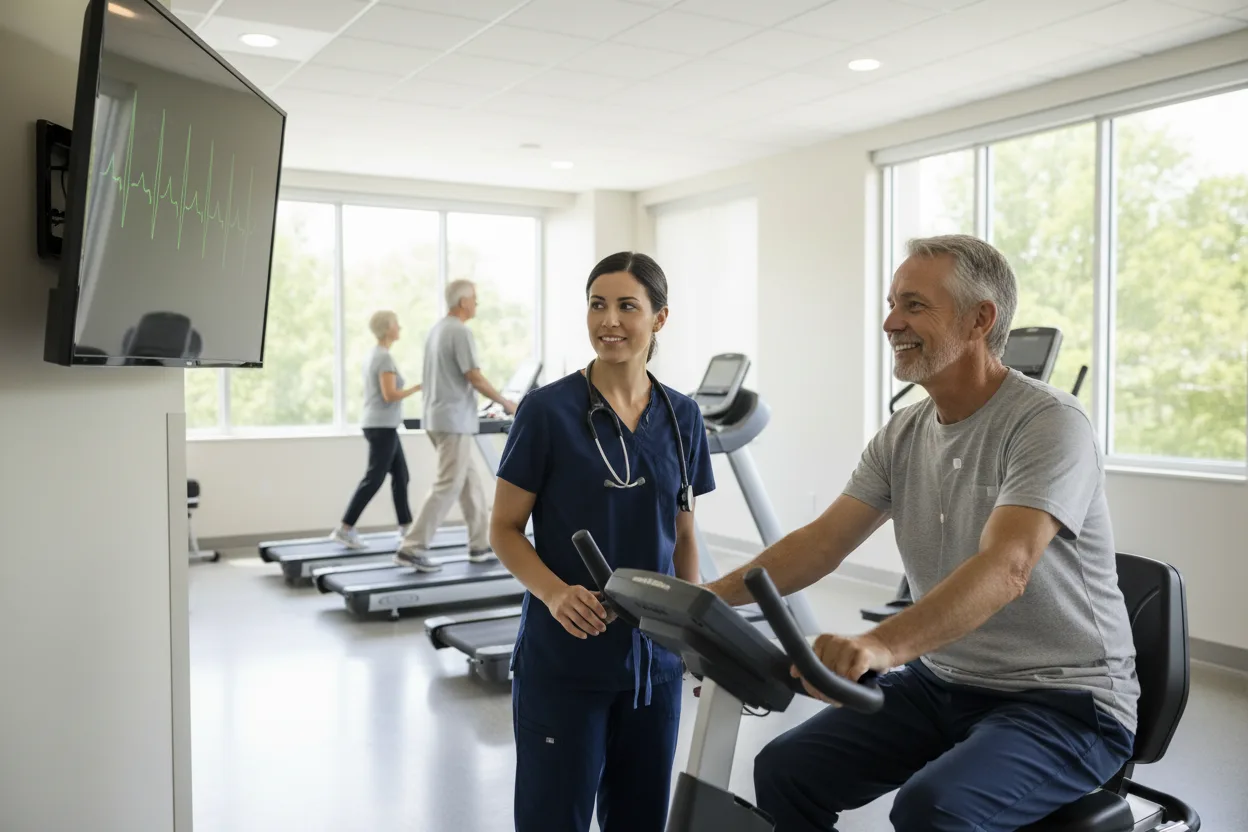
A cardiac rehabilitation specialist runs the supervised exercise and heart-health coaching that helps people recover after a heart attack, bypass surgery, stent, valve repair or heart failure. Most are exercise physiologists, nurses or therapists. With an exercise science degree, you add clinical hours and usually a credential from the American College of Sports Medicine (ACSM) or the American Association of Cardiovascular and Pulmonary Rehabilitation (AACVPR).
What Does a Cardiac Rehabilitation Specialist Do?
Your patients have had a heart event, and someone has told them to move more. Your job is to show them how to do that safely.
Cleveland Clinic describes a program of about three months, with patients coming in two or three times a week. They ride bikes, walk treadmills and lift weights while staff check heart rate, blood pressure, oxygen level and heart rhythm on an electrocardiogram (EKG).
The specialist is the person watching those numbers. At the first visit you go over each patient’s medical history, medications and fitness level, then build the exercise plan. You raise the intensity slowly as the patient gets stronger, and you’re trained to respond if someone has trouble mid-session.
You also teach. Cleveland Clinic lists nutrition, weight, blood pressure, cholesterol, diabetes and quitting tobacco as part of the work. Patients share the room with other people who’ve had a cardiac event, so you’re coaching a group as much as one person at a time.
What Rules Shape a Cardiac Rehab Program?
Medicare’s rule gives most programs their shape. Under 42 CFR 410.49, a program must include physician-prescribed exercise, risk factor education and counseling, a psychosocial assessment and an outcomes assessment. A physician also has to review and sign each patient’s written treatment plan every 30 days.
A physician or nonphysician practitioner must be immediately available during sessions. Medicare covers up to 36 one-hour sessions over as many as 36 weeks, with up to 2 sessions a day. The rule also allows another 36 sessions if the Medicare Administrative Contractor approves them.
Patients qualify after events such as a heart attack in the last 12 months, bypass surgery, stable angina, valve repair or replacement, angioplasty or stenting, a heart or heart-lung transplant, or stable chronic heart failure. Medicare.gov lists the same conditions.
One thing the rule doesn’t do is name a job title for the staff who lead exercise. So the credentials you need come from the employer’s posting, not from Medicare.
Is a Cardiac Rehab Exercise Physiologist the Same Job?
Sometimes. “Cardiac rehab specialist” is a working title, not a license. Nurses, respiratory therapists, physical therapists and exercise physiologists all fill these roles.
The cardiac rehab exercise physiologist is the version built from an exercise science degree. O*NET’s page for exercise physiologists lists Cardiopulmonary Rehabilitation Practitioner, Cardiopulmonary Rehabilitation Therapist and Clinical Cardiac Exercise Physiologist among the reported job titles.
If you want the broader picture of that career, start with our guide to becoming an exercise physiologist.
How Do You Become a Cardiac Rehab Specialist With an Exercise Science Degree?
Five steps get you there. The order matters less than the fact that step three can’t be done online.
-
Earn a bachelor’s degree. Exercise science, exercise physiology or kinesiology fit best. O*NET surveyed people in the exercise physiologist occupation: 50% said a bachelor’s was required, 42% said a master’s, and 4% said a postsecondary certificate.
-
Get CPR training. The ACSM-CEP asks for Basic Life Support Provider or CPR for the Professional Rescuer.
-
Log hands-on clinical hours. ACSM asks for 1,200 hours with a bachelor’s or 600 with a master’s in clinical exercise physiology or an equivalent. AACVPR asks for 1,200 hours in cardiac rehab or secondary prevention.
-
Pass an exam. That’s the ACSM-CEP, the AACVPR CCRP, or both.
-
Keep the credential current. Both run on three-year cycles and require continuing education.
The hours are where people get stuck. Twelve hundred hours is about 30 weeks of full-time work at 40 hours a week (1,200 divided by 40). Ask any program how many of those hours its internship supplies, and where you’d find the rest.
What Is the AACVPR Certification?
The AACVPR certification for individuals is the Certified Cardiac Rehabilitation Professional, or CCRP. AACVPR also certifies programs, which is a different thing. When a hospital says its program is “AACVPR certified,” that’s the program, not you.
To sit for the CCRP, you need 1,200 clinical hours in cardiac rehab or secondary prevention. You also need one of three things: a bachelor’s or higher in a health-related field, a current RN license, or a current RRT credential (respiratory therapist) with an associate degree.
The exam has 140 multiple-choice questions, 120 of them scored, and you get three hours. It’s offered in February, May, September and November windows at Pearson VUE testing centers. The 2026 fee is $335 for AACVPR members and $435 for non-members, per AACVPR’s exam page.
AACVPR requires no course or training program before the exam. Its pass-rate table shows 191 of 284 candidates passing in 2025, or 67.3%, and 66.2% in 2024.
AACVPR says there are 1,244 CCRPs worldwide as of 2026. The credential holds NCCA accreditation through February 28, 2031.
You recertify every three years with 60 continuing education credits, 25 of them AACVPR-approved, for $95 (members) or $135 (non-members). You can also retake the exam. The recertification page has the details.
ACSM-EP, ACSM-CEP or CCRP: Which Credential Fits?
They overlap, but they don’t ask the same things. The ACSM-EP is the exercise physiologist credential and needs a degree but no logged hours. The ACSM-CEP is the clinical version. The CCRP is built around cardiac rehab and opens to nurses and respiratory therapists too.
| ACSM-EP | ACSM-CEP | AACVPR CCRP | |
|---|---|---|---|
| Full name | Certified Exercise Physiologist | Certified Clinical Exercise Physiologist | Certified Cardiac Rehabilitation Professional |
| Education | Bachelor’s in exercise science, exercise physiology or kinesiology | Bachelor’s in exercise science or exercise physiology, or master’s in clinical exercise physiology, or equivalent | Health-related bachelor’s, RN license, or RRT with associate degree |
| Hours | None | 1,200 (bachelor’s) or 600 (master’s) | 1,200 in cardiac rehab or secondary prevention |
| Exam fee | $350 member, $460 non-member | $350 member, $460 non-member | $335 member, $435 non-member |
| Also needed | Adult CPR/AED, First Aid from 2027 | Basic Life Support Provider or CPR for the Professional Rescuer | None beyond the education and hours |
| Renewal | 3 years, 60 CECs, $70 | 3 years, 60 CECs, $70 | 3 years, 60 credits, $95 or $135 |
ACSM says the CEP helps patients with education, behavior change and prevention as part of a healthcare team. That’s the same work you’d do in cardiac rehab, which is why the ACSM clinical exercise physiologist credential comes up so often.
The ACSM-EP needs no logged hours, so it’s the one you can earn right after the degree. Our ACSM exercise physiologist guide covers it.
Pick with job postings, not guesswork. Pull up five cardiac rehab openings in the region where you’d live and note which credential each names. Then aim at the credential that shows up most.
Does the 2027 CAAHEP Rule Change Which Degree You Pick?
Yes, if ACSM is on your list. Starting August 15, 2027, ACSM-EP and ACSM-CEP candidates must graduate from a program accredited by the Commission on Accreditation of Allied Health Education Programs (CAAHEP), or from one that has started the process with a formal inquiry or a Request for Accreditation Services.
The rule points at a specific kind of program. ACSM’s requirements page says the ACSM-EP needs a CAAHEP exercise science bachelor’s. The ACSM-CEP needs either a CAAHEP exercise science bachelor’s plus 1,200 hours or a CAAHEP exercise physiology master’s plus 600 hours.
ACSM also built in transition rules:
-
Graduates before August 15, 2027 send transcripts and course descriptions showing they meet today’s requirements.
-
Graduates on or after that date may qualify under a temporary exemption through August 14, 2029. They send transcripts, course descriptions and a signed attestation from their program director.
-
Students in their final semester can still sit for the exam once coursework and practical requirements are met, according to ACSM’s May 2026 update.
ACSM says it will reassess the rule in 2029. Ask ACSM directly how your graduation date fits before you commit to a program.
The CCRP eligibility list asks for a bachelor’s from an accredited college or university. It doesn’t mention CAAHEP. Our accreditation guide explains the accreditors in full.
Which Online Degrees Fit a Cardiac Rehab Path?
Fourteen of the 168 online programs in our data say they prepare you for the ACSM-CEP. We rank 15 online master’s programs on our clinical exercise physiology list, and the wider online exercise physiology ranking has 24. These are the ones that matter most for cardiac rehab.
States CAAHEP accreditation
-
University of Mary MS in Clinical Exercise Physiology. Online with a one-week campus lab in Bismarck, ND each semester, plus clinical internships. It runs two years, admits once a year and charges $670 per credit for 2026-27, plus a $55 per-credit technology fee.
-
Lebanon Valley College MS in Clinical Exercise Physiology. Three residency weekends in Annville, PA and a 600-hour in-person internship in a cardiopulmonary or rehabilitation exercise program. It’s 33 credits at $789, about $26,037 before aid.
-
Northeastern State University BS in Health and Human Performance. A fully online bachelor’s that lists CAAHEP accreditation, 120 credits at $279 per credit, and a Clinical Health and Wellness option. The school doesn’t say how online students arrange the required practicum.
Cardiac rehab in the internship or coursework
-
University of Wisconsin-River Falls MS in Clinical Exercise Physiology. The internship, EXSS 774, is 3 to 6 credits in cardiac or pulmonary rehabilitation. It’s 34 credits at $567, about $19,278, with one campus weekend per semester.
-
Franklin University MS in Exercise Science, Clinical Exercise Physiology. Fully online, 32 credits at $690 (about $22,080), a hands-on clinical internship, and no prerequisites. Franklin lists availability by state.
-
Tiffin University MS in Clinical Exercise Physiology. Fully online with six starts a year. The 150-hour internship can come from your current job. Tiffin doesn’t state ACSM-CEP preparation, and 150 hours is a quarter of the 600 ACSM asks for with a master’s (150 divided by 600).
-
Commonwealth University of Pennsylvania MS in Applied Exercise Physiology. Fully online, with EXER 511, ECG, Exercise Testing, and Cardiac Rehabilitation as an elective and a six-credit practicum or thesis.
-
Liberty University MS in Human Performance. Its clinical specialization includes EXSC 610, Graded Exercise Testing and Electrocardiography, and EXSC 635, Cardiac and Pulmonary Disorders. Two week-long campus intensives are required, and the program has no internship.
Calvin University runs a different kind of option. Its Cardiac Rehabilitation Graduate Certificate is three fully online courses, about six months full time, at $720 per credit for an estimated $5,760. It’s a certificate, not a degree. Calvin says it prepares you for the 1,200-hour internship, and the certificate also feeds into the Calvin MS in Exercise Science.
How Much Does a Cardiac Rehab Specialist Make?
BLS doesn’t track cardiac rehab specialists as their own group. The closest match is exercise physiologists, and the May 2025 BLS figures for them are a median of $59,460 a year and a mean of $60,940. The middle half earns between $49,620 and $67,230, and the top 10% earn $80,560 or more.
At the bottom, the 10th percentile is $42,760. The hourly median is $28.59. Those figures cover 8,560 exercise physiologists nationwide, whatever setting they work in.
Calvin’s certificate page puts the average for cardiac rehab specialists around $58,000, which is close. Nurses and therapists who work in cardiac rehab are paid on their own occupations’ scales, so their pay differs from these numbers.
Location matters. Our exercise physiologist salary guide breaks out 42 states.
What Is the Job Outlook for Cardiac Rehab Work?
O*NET marks exercise physiologists as a Bright Outlook occupation. It projects growth of 7% or higher from 2024 to 2034 and 1,700 openings from growth and replacement over that period.
Treat that as a national signal, not a promise about your city. Only 8,560 people fall under this BLS title, so a given metro area may have a handful of positions.
If you’re comparing careers, our exercise science jobs guide sets cardiac rehab next to other options.
What Are the Downsides of Cardiac Rehab Work?
Three things are worth knowing before you plan around it.
The hours are a real barrier. You can’t sit for the CCRP or the ACSM-CEP straight out of your degree on the bachelor’s route. Plan for the hours before you enroll, and ask whether your program places you.
Online only covers part of it. Most programs above pair online courses with in-person clinical work, and four of them add campus visits. If you can’t travel or arrange a hospital placement locally, say so early.
Your patients are recovering from heart events. Emergencies are part of the job, and staff are trained to respond to them. That carries a weight that a fitness-center job doesn’t.
Pay lands near the $59,460 median, and some people find that thin for a job that asks for a degree plus 1,200 hours. If you’re already a nurse or respiratory therapist, the CCRP may be a shorter route than a second degree.
How We Checked These Facts
We read AACVPR’s CCRP, exam and recertification pages, ACSM’s CEP and 2027 requirement pages, the Medicare rule and the O*NET page on September 29, 2026. Wage figures come from BLS OEWS May 2025. Program details come from each school’s own pages and are recorded in the program reviews linked above.
AACVPR and ACSM can change fees and rules. Confirm on AACVPR’s CCRP page and ACSM’s CEP page before you apply. If a school page says something different from what we’ve written, let us know.
Exercise Physiologists Pay by State
In May 2025, the Bureau of Labor Statistics reported a median annual wage of $59,460 for exercise physiologists nationwide, with the middle half earning between $49,620 and $67,230. About 8,560 people held these jobs.
Washington had the highest published state median at $81,310, and Mississippi the lowest at $43,060. The table lists every state where BLS publishes a median for this occupation.
| State | Median | 10th Percentile | 90th Percentile | Jobs |
|---|---|---|---|---|
| Washington | $81,310 | $65,830 | $97,620 | 160 |
| Oregon | $71,630 | $56,010 | $81,260 | 80 |
| Minnesota | $67,230 | $61,640 | $95,140 | 250 |
| Massachusetts | $65,950 | $60,060 | $97,370 | 180 |
| New Jersey | $64,680 | $55,620 | $79,290 | 130 |
| Colorado | $63,800 | $45,210 | $75,350 | 370 |
| New Hampshire | $63,590 | $51,630 | $79,050 | 50 |
| Wisconsin | $63,210 | $55,100 | $77,320 | 340 |
| Connecticut | $62,510 | $46,570 | $81,740 | 100 |
| California | $62,440 | $36,970 | $106,290 | 640 |
| Arizona | $62,350 | $51,950 | $77,630 | 220 |
| Maryland | $62,220 | $50,980 | $76,130 | 90 |
| Wyoming | $62,070 | $49,620 | $97,800 | |
| Illinois | $60,130 | $50,220 | $84,020 | 300 |
| Florida | $60,100 | $47,800 | $88,070 | 330 |
| New York | $59,940 | $53,610 | $107,800 | 360 |
| Kansas | $59,090 | $49,830 | $73,550 | 60 |
| Georgia | $58,170 | $44,980 | $80,510 | 210 |
| Delaware | $57,940 | $41,960 | $83,910 | 90 |
| Texas | $56,780 | $36,890 | $79,150 | 520 |
| Idaho | $56,750 | $49,550 | $74,650 | 40 |
| Iowa | $56,640 | $45,190 | $75,530 | 50 |
| Nevada | $55,240 | $55,230 | $60,410 | |
| Michigan | $55,080 | $48,140 | $65,910 | 570 |
| Tennessee | $53,570 | $40,620 | $73,360 | 140 |
| Missouri | $52,570 | $46,700 | $69,260 | 160 |
| Louisiana | $52,450 | $40,410 | $81,330 | 40 |
| North Carolina | $52,450 | $43,900 | $71,270 | 370 |
| Virginia | $52,400 | $43,800 | $90,110 | 240 |
| Ohio | $51,660 | $44,310 | $71,560 | 340 |
| South Dakota | $51,630 | $48,390 | $71,540 | 30 |
| Kentucky | $51,070 | $45,960 | $64,810 | 60 |
| Alabama | $50,820 | $40,540 | $76,910 | 70 |
| North Dakota | $50,430 | $49,030 | $64,590 | 50 |
| West Virginia | $50,270 | $47,290 | $75,400 | 60 |
| Indiana | $49,740 | $34,060 | $71,130 | 310 |
| Oklahoma | $49,190 | $43,240 | $57,830 | 80 |
| Arkansas | $48,850 | $40,800 | $66,890 | 40 |
| Pennsylvania | $48,040 | $38,900 | $67,820 | 640 |
| South Carolina | $46,550 | $32,100 | $64,420 | 230 |
| Utah | $43,850 | $28,860 | $73,570 | 220 |
| Mississippi | $43,060 | $34,980 | $93,640 | 30 |
Frequently Asked Questions
Is a Cardiac Rehab Specialist the Same as a Cardiac Rehab Exercise Physiologist?
Do You Need a Master's Degree to Work in Cardiac Rehab?
What Is the AACVPR Certification?
How Much Does a Cardiac Rehab Specialist Make?
Can You Become a Cardiac Rehab Specialist Online?
How Long Does It Take to Become a Cardiac Rehab Specialist?
Which Certification Should You Get First, ACSM-CEP or CCRP?
Sources
- Certified Cardiac Rehabilitation Professional
- CCRP About the Exam
- CCRP Recertification
- CCRP Exam Pass Rate 2017 to 2025
- Clinical Exercise Physiologist
- 2027 ACSM-EP and ACSM-CEP Accreditation and Certification Requirements
- Certification Pathway for Students in Programs Seeking CAAHEP Accreditation
- 42 CFR 410.49, Cardiac Rehabilitation Conditions of Coverage
- Cardiac Rehabilitation Program Coverage
- Cardiac Rehabilitation Specialist
- Exercise Physiologists, 29-1128.00
- Occupational Employment and Wage Statistics, May 2025
All sources retrieved .