

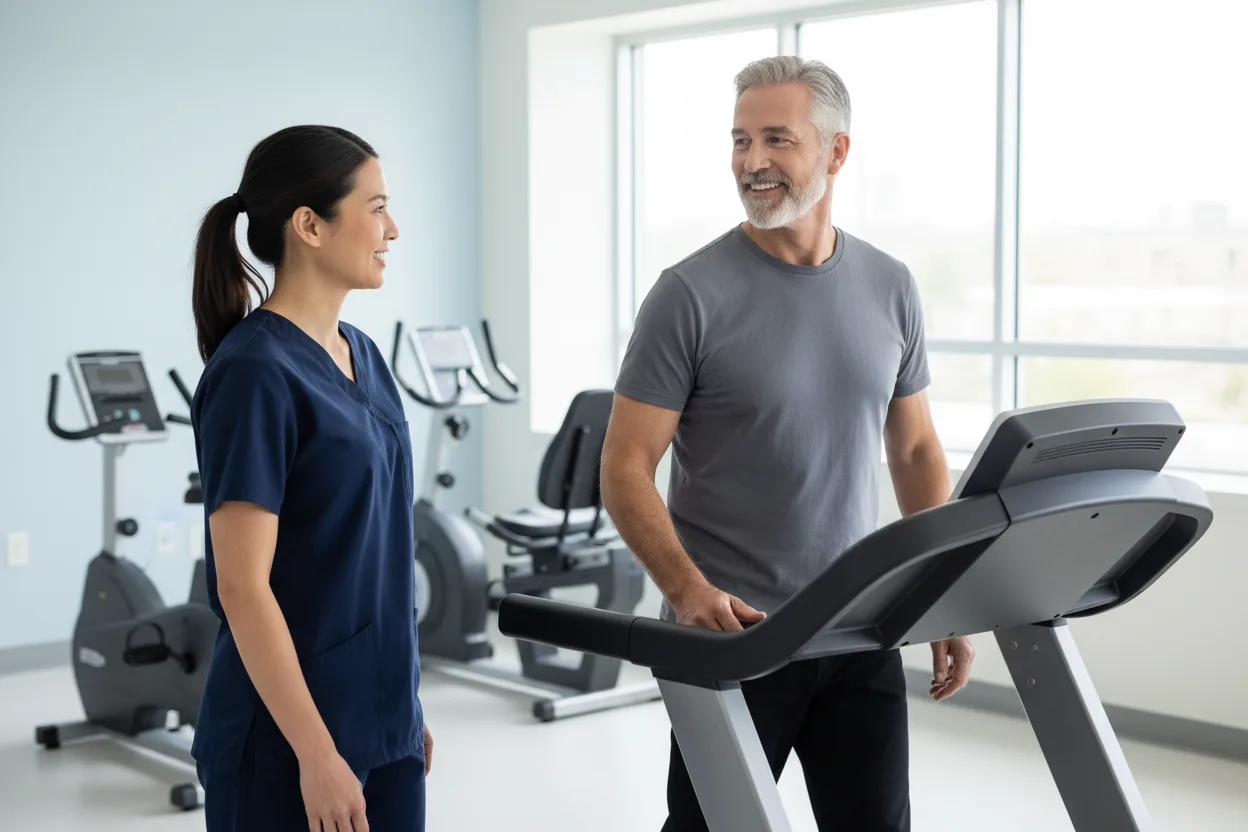
Exercise physiologist jobs are mostly clinical. You test how a person’s heart and lungs handle exercise, then build and supervise a program around the results, most often in cardiac rehab. A bachelor’s degree in exercise science is the usual starting point, and the BLS median pay is $59,460 a year. Job titles vary a lot, so you’ll search under several names.
What Are the Main Exercise Physiologist Jobs?
The first snag in searching for exercise physiologist jobs is that employers rarely agree on a title. O*NET lists reported titles such as Clinical Exercise Physiologist, Cardiopulmonary Rehabilitation Practitioner, Clinical Exercise Specialist and Exercise Scientist.
Grand Valley State University’s open cardiac rehab textbook adds the search words that surface openings in each setting.
| Setting | Titles to Search | What the Work Centers On |
|---|---|---|
| Cardiac and pulmonary rehab | Cardiac Rehab, Exercise Physiologist | Leading exercise sessions, taking vital signs, watching EKG rhythms, running stress tests |
| Fitness programs for members with health conditions | Exercise Specialist, Fitness Specialist, Fitness Coordinator | Health risk appraisals, fitness testing, classes for people with conditions such as Parkinson’s disease or stroke |
| Corporate and community wellness | Wellness Coach, Corporate Wellness, Health Coach, Health Promotion | Screenings, personal wellness plans, health fairs, group classes |
| Sports performance | Strength and Conditioning Coach, Sports Performance, Sports Scientist | Team and individual programs, assessments, injury risk reduction |
Cardiac rehab and stress testing in a hospital or clinic is the setting people usually picture. O*NET lists health care and social assistance as the occupation’s top industry.
The other rows overlap with fitness and coaching work. Our guides to exercise science jobs and the cardiac rehab specialist career cover those routes in more detail.
What Does an Exercise Physiologist Do All Day?
The exercise physiologist job description comes down to testing, prescribing and supervising. O*NET’s most important tasks include explaining testing procedures, writing exercise programs to exercise science and credentialing standards, giving clinical oversight of exercise at every risk level, and taking a medical history.
Further down its list of 27 tasks you’ll find EKG stress tests, measuring oxygen use with a spirometer and teaching behavior-change classes.
ACSM describes its Certified Exercise Physiologists as people who conduct and interpret fitness assessments and write exercise prescriptions for people who are healthy or have medically controlled diseases. Its clinical credential is aimed at people who join a healthcare team and help patients through education, behavior change and prevention.
Now picture a weekday in an outpatient cardiac rehab gym, using the duties that Cleveland Clinic’s exercise physiologist listing describes. You start by reading charts and interviewing each patient about how they’ve felt since the last visit.
Then you supervise the session. You check vital signs, EKG strips, a rating of perceived exertion, pain and blood glucose before, during and after exercise. You calculate each exercise prescription from the person’s test results and clinical status, teach patients and their families about cardiac risk, and write home activity guidelines for people recovering from surgery.
It isn’t always calm. O*NET lists giving emergency care to participants who show signs of physical distress as a core task, which is why CPR and BLS certification appears in the requirements below. On stress test days you may spend hours attaching EKG leads, tracking blood pressure and doing preliminary test interpretation.
What Do Exercise Physiologist Jobs Pay?
BLS OEWS puts the median for exercise physiologists at $59,460 a year, or $28.59 an hour, as of May 2025. The mean is $60,940. The middle half of workers earn between $49,620 and $67,230.
| Percentile | Annual Wage |
|---|---|
| 10th | $42,760 |
| 25th | $49,620 |
| Median | $59,460 |
| 75th | $67,230 |
| 90th | $80,560 |
Where you work moves the number. The highest mean wages are in Washington ($81,870, with 160 workers), Minnesota ($72,750, with 250 workers) and Massachusetts ($72,210, with 180 workers). Those are small samples, so treat them as direction and not a promise.
Our exercise physiologist salary page has the full state table.
For context, personal trainers and group fitness instructors have a $47,160 median and need a certification instead of a degree. Physical therapists have a $102,760 median but need a doctorate and a license. The comparison table further down lays that out.
How Many Exercise Physiologist Jobs Are There?
Not many, and you should know that before you plan around it. OEWS counts 8,560 exercise physiologists nationally. The BLS employment projections shown on O*NET list 23,900 jobs in the occupation for 2024. The two counts come from different BLS products, and both describe a small occupation.
On growth, O*NET carries the BLS projection of much faster than average for 2024 to 2034, which means 7% or higher. It also lists 1,700 projected openings from growth and replacement. That’s a good direction on a small base. Spread across the country, it isn’t a lot of openings, so clinical hours and credentials do real work on your application.
California and Pennsylvania lead in employment with 640 workers each. Michigan has 570, Texas 520 and Colorado 370.
What Are the Exercise Physiologist Requirements?
O*NET places the job in Job Zone Four, where “most of these occupations require a four-year bachelor’s degree, but some do not.” Employers then add layers on top. Here are the ones you’ll run into.
A bachelor’s degree. The ACSM Certified Exercise Physiologist credential (ACSM-EP) asks for at least a bachelor’s in exercise science, exercise physiology or kinesiology, plus adult CPR/AED certification. First aid certification joins the list starting in 2027. The exam costs $460, or $350 for ACSM members, and a retest is $235.
An accredited program, from August 15, 2027. ACSM says candidates for the ACSM-EP and the clinical credential must graduate from an exercise science or exercise physiology program accredited by CAAHEP, the Commission on Accreditation of Allied Health Education Programs. A program that has started the process with a formal inquiry or a Request for Accreditation Services also counts.
Clinical hours for the clinical credential. The ACSM Certified Clinical Exercise Physiologist (ACSM-CEP) needs either a master’s in clinical exercise physiology or equivalent plus 600 hours of hands-on clinical experience, or a bachelor’s in exercise science or exercise physiology or equivalent plus 1,200 hours.
A hospital’s own checklist. Cleveland Clinic’s exercise physiologist page asks for a master’s degree, a three to six month clinical internship in stress testing or cardiac rehab, and BCLS certification.
It also wants 12-lead EKG interpretation skills and an ACSM certification within a year of hire. The page carries a 03/16 stamp, so it may be years old. Treat it as an example of how high one employer set the bar, not as today’s posting.
Extra hospital credentials. The Grand Valley State textbook says most internships give about 600 hours, so entry-level positions usually expect certification within one year of hire. It adds that Advanced Cardiac Life Support (ACLS) is typically required as part of hospital employment.
A state license in some places. Louisiana’s medical board rules list clinical exercise physiologists among the professions licensed under state law (R.S. 37:3421 et seq.). If you plan to work there, ask the board what education it requires before you pick a program.
Here’s how the two ACSM credentials compare.
| ACSM-EP | ACSM-CEP | |
|---|---|---|
| Built for | People who are healthy or have medically controlled disease | Patients, as part of a healthcare team |
| Degree | Bachelor’s in exercise science, exercise physiology or kinesiology | Master’s in clinical exercise physiology or equivalent, or bachelor’s in exercise science or exercise physiology or equivalent |
| Clinical hours | Not part of the qualifications | 600 with the master’s, 1,200 with the bachelor’s |
| CPR | Adult CPR/AED | BLS Provider or CPR for the Professional Rescuer |
| Exam fee | $460 ($350 for members) | $460 ($350 for members) |
| Renewal | Every 3 years, 60 CECs, $70 | Every 3 years, 60 CECs, $70 |
Our guides to the ACSM exercise physiologist certification and the clinical version walk through each exam.
How to Become an Exercise Physiologist, Step by Step
Most people who want exercise physiologist jobs in a hospital follow the same order. If your target is wellness or fitness work, you can stop earlier, because those roles often lean on a bachelor’s alone.
-
Pick the job before the degree. Cardiac rehab and stress testing need clinical hours, and some employers ask for a master’s. Corporate wellness and fitness programs usually ask for less. Pull three postings and note what each one requires.
-
Choose a program with the 2027 rule in mind. Look for CAAHEP accreditation, or ask the program in writing whether it has filed a formal inquiry or a Request for Accreditation Services. Our certification-ready ranking tracks the online programs that hold CAAHEP or CASCE accreditation.
-
Get CPR and BLS certification early. ACSM asks for CPR/AED, and the Grand Valley State textbook notes BLS is often required just to start an internship.
-
Log clinical hours while you study. Ask each program who finds the internship site and how many hours it counts. Keep an experience log from day one, because ACSM’s clinical application asks you to document your hours.
-
Sit for the ACSM-EP or the ACSM-CEP. The EP needs the degree. The CEP needs the degree plus 600 or 1,200 hours, and you apply before you can register for the exam.
-
Add the hospital extras. Learn 12-lead EKG interpretation, get ACLS if the employer asks, and think about the AACVPR Certified Cardiac Rehabilitation Professional credential later. It requires 1,200 clinical hours in cardiac rehab and a health-related bachelor’s degree, RN license or qualifying respiratory credential.
On timing, a bachelor’s is 120 credits at most programs on our list. A master’s in clinical exercise physiology can be quick. Lebanon Valley describes about one year of coursework, then a 600-hour internship, and Tiffin lists 12 months.
On cost, the median total tuition across our online programs is $54,240 for a bachelor’s and $20,200 for a master’s. The master’s number is lower because it covers far fewer credits.
Can You Become an Exercise Physiologist With an Online Degree?
Yes for the coursework. No for the clinical hours, which happen in person at a hospital or clinic. Four of the 168 programs on our list report CAAHEP accreditation, and only one of those is a bachelor’s. So you’ll be choosing between accreditation, price and how much travel you can do.
Here are five programs that show the range.
| Program | Format | Cost per Credit | Clinical or On-Site Piece |
|---|---|---|---|
| Northeastern State University BS in Health and Human Performance | Fully online, 120 credits | $278 to $279 | Practicum (P ED 4810) required |
| Lebanon Valley College MS in Clinical Exercise Physiology | Online with residencies, 33 credits | $789 | Three weekends in Annville, Pennsylvania, and a 600-hour internship |
| University of Mary MS in Clinical Exercise Physiology | Blended, about 2 years | $670 | One-week on-site lab each semester in Bismarck, North Dakota, plus clinical internships |
| Tiffin University MS in Clinical Exercise Physiology | Fully online, 31 credits, 12 months, asynchronous | $755 | 150-hour internship that can come from your current job |
| Grand Canyon University MS in Exercise Physiology | Fully online, 34 credits, 8-week courses | $610 | 600 practicum hours |
Here’s how to read that table. Lebanon Valley and Mary both list CAAHEP accreditation and prepare you for the ACSM-CEP. Lebanon Valley’s course list includes two ECG Interpretation courses and Pharmacology, which is the skill set hospital postings ask for.
Northeastern State’s bachelor’s is listed with CAAHEP as an exercise science program, but the listing is for the campus program in Tahlequah, Oklahoma, and it carries no distance flag. Ask the department in writing that online students are covered. Its own page also says no certifications relate to the degree.
Tiffin and Grand Canyon don’t list CAAHEP accreditation on their program pages. Tiffin’s 150 hours is short of the 600 that ACSM lists for a master’s, so you’d need to find the other 450 hours yourself. Grand Canyon’s 600 practicum hours match ACSM’s number, but ACSM’s wording is “or equivalent,” so ask ACSM whether the degree counts.
Our rankings sort these by score, cost and format. Start with the online clinical exercise physiology master’s programs or the wider list of online exercise physiology degrees. If your bachelor’s is in another field, the career changer ranking shows programs that accept it. For a first degree, see the online bachelor’s in exercise science ranking.
Exercise Physiologist vs Personal Trainer vs Physical Therapist
People often mix these up when they search for exercise physiologist jobs. They differ in pay and, more importantly, in what the employer requires.
| Job | Median Pay (May 2025) | What Gates Entry |
|---|---|---|
| Exercise physiologist | $59,460 | Bachelor’s typical, ACSM-EP or ACSM-CEP credentials, and a master’s for many hospital roles |
| Exercise trainer and group fitness instructor | $47,160 | A personal trainer certification, not a degree |
| Athletic trainer | $62,520 | Professional master’s from a CAATE-accredited program plus the BOC exam |
| Physical therapist | $102,760 | Doctor of Physical Therapy degree plus a state license |
An exercise science degree is a common route into physical therapy school, but the prerequisites include lab sciences that many online programs limit. Our exercise science vs physical therapy guide covers the gap, and the pre-physical therapy ranking flags programs where you’d finish labs in person. Athletic training is its own path, and our athletic trainer salary page explains it.
The step from $59,460 to $102,760 is large, and it comes with years of extra school. Some people are happy staying in clinical exercise. Others use it as a way to test the health care setting before applying to a doctorate.
What Are the Downsides of Exercise Physiologist Jobs?
The work is meaningful to a lot of people, but it comes with real limits.
The pay is modest. A $59,460 median sits below physical therapy, and the 90th percentile of $80,560 is the ceiling for most of the field. Master’s degrees can help for clinical lead and research roles, but they cost time and tuition.
Requirements are moving. The 2027 CAAHEP rule means the degree you pick now decides which credential you can earn. Clinical hours are often unpaid or low paid, and you have to find the sites.
It’s a small market. With 8,560 workers counted by OEWS, you may compete with people who have more clinical experience. Volunteering in a cardiac rehab program while you study is one way to close that gap.
The work can be stressful. Patients have heart and lung disease, and O*NET lists emergency care as a core task. If watching an EKG tracing change while someone exercises sounds like more than you want, shadow a session before you commit.
Most of it happens in person. EKG stress tests and vital sign checks don’t work over video. The cardiac rehab association AACVPR does publish resources for virtual and hybrid delivery, so some roles exist, but you should plan to work on site.
Search results can mislead you. Many of the top results for “what does an exercise physiologist do” come from Australian clinics, where the job and its pathway differ from the U.S. one described here.
Where Should You Look for Exercise Physiologist Jobs?
Start with the titles in the first table, and search each one with your city. Then go to the source. ACSM and AACVPR both run career centers, and large hospital systems post their exercise physiologist and cardiac rehab roles on their own careers pages.
Read each posting for the same short list: degree level, ACSM-EP or ACSM-CEP, BLS or ACLS, and EKG skills. If three postings in your area want a master’s, that’s your answer on degree level. If they want a bachelor’s and CPR, you may be closer than you thought.
How We Checked These Facts
We read the ONET, ACSM, CAAHEP, AACVPR and Louisiana rule pages on September 29, 2026. BLS blocks automated fetching, so the wage figures come from our BLS OEWS May 2025 data, and ONET’s median matches them. Program details come from each school’s own pages, recorded in the program reviews linked above.
Credential rules and program details change. Confirm on ACSM’s exercise physiologist page and the school’s page before you apply, and tell us if something here doesn’t match.
Exercise Physiologists Pay by State
In May 2025, the Bureau of Labor Statistics reported a median annual wage of $59,460 for exercise physiologists nationwide, with the middle half earning between $49,620 and $67,230. About 8,560 people held these jobs.
Washington had the highest published state median at $81,310, and Mississippi the lowest at $43,060. The table lists every state where BLS publishes a median for this occupation.
| State | Median | 10th Percentile | 90th Percentile | Jobs |
|---|---|---|---|---|
| Washington | $81,310 | $65,830 | $97,620 | 160 |
| Oregon | $71,630 | $56,010 | $81,260 | 80 |
| Minnesota | $67,230 | $61,640 | $95,140 | 250 |
| Massachusetts | $65,950 | $60,060 | $97,370 | 180 |
| New Jersey | $64,680 | $55,620 | $79,290 | 130 |
| Colorado | $63,800 | $45,210 | $75,350 | 370 |
| New Hampshire | $63,590 | $51,630 | $79,050 | 50 |
| Wisconsin | $63,210 | $55,100 | $77,320 | 340 |
| Connecticut | $62,510 | $46,570 | $81,740 | 100 |
| California | $62,440 | $36,970 | $106,290 | 640 |
| Arizona | $62,350 | $51,950 | $77,630 | 220 |
| Maryland | $62,220 | $50,980 | $76,130 | 90 |
| Wyoming | $62,070 | $49,620 | $97,800 | |
| Illinois | $60,130 | $50,220 | $84,020 | 300 |
| Florida | $60,100 | $47,800 | $88,070 | 330 |
| New York | $59,940 | $53,610 | $107,800 | 360 |
| Kansas | $59,090 | $49,830 | $73,550 | 60 |
| Georgia | $58,170 | $44,980 | $80,510 | 210 |
| Delaware | $57,940 | $41,960 | $83,910 | 90 |
| Texas | $56,780 | $36,890 | $79,150 | 520 |
| Idaho | $56,750 | $49,550 | $74,650 | 40 |
| Iowa | $56,640 | $45,190 | $75,530 | 50 |
| Nevada | $55,240 | $55,230 | $60,410 | |
| Michigan | $55,080 | $48,140 | $65,910 | 570 |
| Tennessee | $53,570 | $40,620 | $73,360 | 140 |
| Missouri | $52,570 | $46,700 | $69,260 | 160 |
| Louisiana | $52,450 | $40,410 | $81,330 | 40 |
| North Carolina | $52,450 | $43,900 | $71,270 | 370 |
| Virginia | $52,400 | $43,800 | $90,110 | 240 |
| Ohio | $51,660 | $44,310 | $71,560 | 340 |
| South Dakota | $51,630 | $48,390 | $71,540 | 30 |
| Kentucky | $51,070 | $45,960 | $64,810 | 60 |
| Alabama | $50,820 | $40,540 | $76,910 | 70 |
| North Dakota | $50,430 | $49,030 | $64,590 | 50 |
| West Virginia | $50,270 | $47,290 | $75,400 | 60 |
| Indiana | $49,740 | $34,060 | $71,130 | 310 |
| Oklahoma | $49,190 | $43,240 | $57,830 | 80 |
| Arkansas | $48,850 | $40,800 | $66,890 | 40 |
| Pennsylvania | $48,040 | $38,900 | $67,820 | 640 |
| South Carolina | $46,550 | $32,100 | $64,420 | 230 |
| Utah | $43,850 | $28,860 | $73,570 | 220 |
| Mississippi | $43,060 | $34,980 | $93,640 | 30 |
Frequently Asked Questions
What Do Exercise Physiologist Jobs Pay?
Do You Need a Master's for Exercise Physiologist Jobs?
What Is the Difference Between an Exercise Physiologist and a Clinical Exercise Physiologist?
Are Exercise Physiologist Jobs in Demand?
Can You Get Exercise Physiologist Jobs With an Online Degree?
Are There Remote Exercise Physiologist Jobs?
How Long Does It Take to Become an Exercise Physiologist?
Sources
- Exercise Physiologists, 29-1128.00
- Occupational Employment and Wages, May 2025: Exercise Physiologists
- Exercise Physiologist Certification
- Clinical Exercise Physiologist Certification
- Programmatic Accreditation Requirement
- Exercise Science Committee on Accreditation
- Careers and Professional Credentialing in Cardiac Rehabilitation
- Careers in CV Health Field: Exercise Physiologist
- Certified Cardiac Rehabilitation Professional
- Louisiana Administrative Code Title 46, Part XLV, Section 441
All sources retrieved .