
Exercise science jobs run from personal trainer, which needs a certification more than a degree, to exercise physiologist, which usually needs a bachelor’s, to physical therapist, which needs a doctorate. With an exercise science bachelor’s you can work in cardiac rehab, coaching, wellness programs or health education. The best-paying jobs with an exercise science degree need more school or more years on the job.
What Can You Do With an Exercise Science Degree?
Most people picture a gym. The list is wider than that, and the pay is more spread out than the job titles suggest. This table covers the jobs an exercise science bachelor’s opens or helps with, using BLS wage data from May 2025 and O*NET projections for 2024 to 2034.
| Job | U.S. Jobs | Median Pay | Pay Range, 10th to 90th Percentile | Growth to 2034 | Usual Requirement |
|---|---|---|---|---|---|
| Exercise physiologist | 8,560 | $59,460 | $42,760 to $80,560 | Much faster than average | Bachelor’s, often the ACSM-EP |
| Personal trainer or group fitness instructor | 322,930 | $47,160 | $28,800 to $83,100 | Much faster than average | Certification, no degree |
| Coach or scout | 248,950 | $47,320 | $28,790 to $98,860 | Faster than average | Bachelor’s, plus a state credential for school coaching |
| Recreational therapist | 14,930 | $61,960 | $40,990 to $100,420 | Average | Bachelor’s plus NCTRC certification |
| Health education specialist | 65,690 | $64,070 | $42,990 to $118,200 | Faster than average | Bachelor’s, CHES often preferred |
| Community health worker | 61,660 | $51,850 | $38,810 to $77,180 | Much faster than average | High school diploma to bachelor’s |
| Occupational health and safety specialist | 140,610 | $90,150 | $55,000 to $134,950 | Much faster than average | Bachelor’s |
| Medical and health services manager | 597,080 | $123,860 | $73,390 to $224,340 | Much faster than average | Bachelor’s, master’s for larger organizations |
| Recreation worker | 331,490 | $36,560 | $27,600 to $50,410 | Average | Varies by role |
Look at the range column before you look at the median. A personal trainer at the 10th percentile earns $28,800. One at the 90th earns $83,100. Same title, very different job.
Only two rows are direct fits for the degree: exercise physiologist and, in practice, trainer or coach. The rest are neighbors. They want someone who understands movement and health, but each adds its own credential, coursework or years of experience. We flag that in every section below.
These are national figures. Your state’s numbers will differ, and our state rankings show state wages for the states where we list programs.
What Are the Best Entry Level Exercise Science Jobs?
Entry level exercise science jobs mostly sit in three places: gyms and fitness studios, community programs, and coaching. They’re the easiest to land, and they pay the least.
Exercise trainers and group fitness instructors are the biggest group by far, with 322,930 jobs and a median of $47,160. O*NET projects much faster than average growth and 74,200 openings from 2024 to 2034. You don’t need a degree. You need a certification such as the NSCA-CPT ($435, or $300 for NSCA members) or the ACSM-CPT ($410, or $310 for ACSM members), plus CPR/AED.
So why get the degree at all? Because it raises the ceiling. It helps you program for clients with health conditions, and it helps you move into gym management, clinical work or team roles. Trainers at the 90th percentile earn $83,100, so the top of the range is worth aiming at.
If you want a degree that’s built around this job, look at the associate route. Lake Region State College’s Fitness Trainer Technician program is fully online and asynchronous.
It’s 60 credits at $238.65 per credit, or $14,319 in total, with 8-week terms and a one-credit internship in the final semester. CAAHEP’s own program search flags it as a distance program, and it was the only one we found marked that way.
You’ll find more choices in our rankings of online associate degrees in exercise science and online exercise science degrees for personal trainers.
Two other doors are open at this level. Community health workers have a median of $51,850 and 61,660 jobs, and O*NET lists bachelor’s-level preparation for the job. Recreation workers have a median of $36,560, the lowest in our table. Both hire people who can lead a class or a program.
Be realistic about starting pay. The 10th percentile column, $28,800 for trainers and $27,600 for recreation workers, is the honest place to look. A specialty certification or a management title is how you move up from there.
What Do Exercise Physiologists Do, and How Many Jobs Are There?
Exercise physiologist is the title that matches the degree, and it’s a small field. BLS counts 8,560 of them across the country, with a median of $59,460. O*NET projects growth of 7% or higher and 1,700 openings from 2024 to 2034.
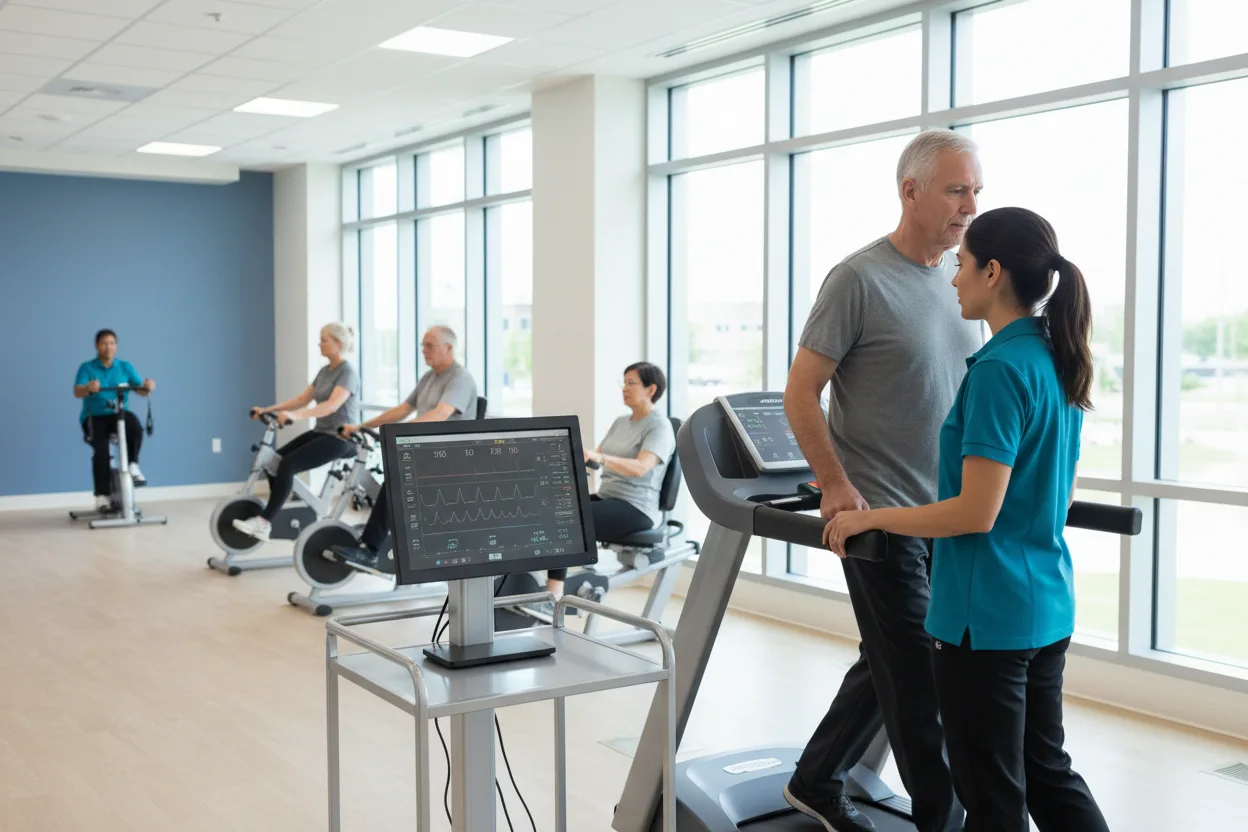
Most of the work is in health care. Cardiac and pulmonary rehab programs, hospitals and wellness programs hire exercise science majors to test patients, write exercise plans and watch how people respond. If you want the full picture of the day-to-day work, read our guide to how to become an exercise physiologist.
Where the jobs are matters. California and Pennsylvania have 640 each, and Michigan has 570. Average pay is highest in Washington ($81,870), Minnesota ($72,750) and Massachusetts ($72,210). Those states have small headcounts, so treat them as hints and see our exercise physiologist salary page for the state table.
The credential to know is the ACSM-EP, the Certified Exercise Physiologist credential from the American College of Sports Medicine (ACSM). It asks for a bachelor’s in exercise science, exercise physiology or kinesiology, plus adult CPR/AED. The exam costs $460, or $350 for ACSM members.
Here’s the rule change that affects online students. ACSM says that from August 15, 2027, ACSM-EP and ACSM-CEP candidates must graduate from a CAAHEP-accredited program, or from one that has started the accreditation process. CAAHEP is the Commission on Accreditation of Allied Health Education Programs. Read our ACSM exercise physiologist certification guide for the details.
Four programs on our list show CAAHEP accreditation. Northeastern State University’s Health and Human Performance bachelor’s is fully online at $279 per credit. Its 120 credits come to $33,480, and the courses include Cardiopulmonary Rehabilitation and Advanced Exercise Prescription. The catalog states the accreditation, so confirm it on CAAHEP’s exercise science page before you enroll.
For a clinical job at the master’s level, Lebanon Valley College’s MS in Clinical Exercise Physiology is online with real in-person parts. It has three residency weekends in Annville, Pennsylvania, and a 600-hour clinical internship. It’s 33 credits at $789 per credit, or $26,037 in total, and it’s built around the ACSM-CEP.
The ACSM-CEP is the clinical exercise physiologist credential. It asks for a bachelor’s plus 1,200 clinical hours, or a master’s plus 600 hours. Louisiana licenses clinical exercise physiologists, so if you live there, check the state’s rules first. Our Louisiana ranking covers what we found.
Start with our lists of online exercise physiology degrees, online clinical exercise physiology master’s programs and certification-ready online degrees.
Which Exercise Science Jobs Need Graduate School?
These are the jobs people usually mean when they say exercise science is a stepping stone. The bachelor’s gets you into the applicant pool. It doesn’t make you a candidate for the license.
| Job | Median Pay | What You Need After the Bachelor’s |
|---|---|---|
| Physical therapist | $102,760 | Doctor of Physical Therapy (DPT), then a state license |
| Occupational therapist | $100,330 | Master’s or OTD, then the NBCOT exam |
| Physician assistant | $135,880 | Master’s, PANCE exam, many patient-care hours |
| Chiropractor | $79,200 | Doctor of Chiropractic (DC), then a license |
| Athletic trainer | $62,520 | Professional master’s from a CAATE-accredited program, then the BOC exam |
| Dietitian or nutritionist | $76,400 | Master’s for the RD credential |
Physical therapy is the most common target, and the pay gap is large. Physical therapists have a median of $102,760, against $59,460 for exercise physiologists. The price of that gap is the DPT, which takes about three years, and the prerequisites you finish first.
Here’s the catch for online students. DPT, PA and chiropractic programs want anatomy and physiology with lab, chemistry and physics, and many limit online lab credit. Read your target program’s prerequisite page before you choose a bachelor’s, and ask where you’d complete the labs.
University of Wisconsin-Superior’s exercise science bachelor’s is fully online at $377.50 per credit, or $45,300 for 120 credits. The school says it prepares you for graduate study in physical therapy, occupational therapy, athletic training, physician assistant work and exercise physiology. Its catalog lists an internship of at least 450 hours.
Athletic training deserves a plain warning. A bachelor’s in exercise science does not qualify you as an athletic trainer. The entry route is a professional master’s from a CAATE-accredited program, followed by the BOC exam. Our guide to exercise science versus athletic training compares the two.
Our pre-physical therapy ranking has 40 programs, and the pre-health ranking has 32. You can also read how exercise science compares with physical therapy before you commit.
What Are the Best-Paying Exercise Science Jobs Without Grad School?
A few well-paid jobs sit next to exercise science. None of them is a straight line from the degree, so read each requirement before you plan around it.
Occupational health and safety specialists have a median of $90,150 and 140,610 jobs. O*NET lists much faster than average growth and 14,900 openings. The work covers ergonomics and workplace injury prevention, and a movement science background carries over. Employers may want safety coursework or credentials on top of your degree, so read a few postings first.
Medical and health services managers have a median of $123,860 and 597,080 jobs. That’s the highest bachelor’s-level median in our table, but you rarely start there. Fitness, rehab and wellness program directors move into it with experience or a master’s in health administration.
Health education specialists have a median of $64,070. Employers often prefer the CHES credential, the Certified Health Education Specialist certification from NCHEC.
University of Louisiana at Lafayette’s kinesiology bachelor’s has a Health Promotion and Wellness concentration that points toward the CHES. It’s fully online at $380 per credit, or $45,600 for 120 credits, with five starts a year.
Recreational therapists have a median of $61,960. They need NCTRC certification, which requires specific coursework and an internship, so an exercise science degree doesn’t cover it automatically. Check the NCTRC requirements against a program’s course list.
Our full list of highest paying exercise science jobs goes further into pay and the routes to each job.
Do Strength Coach and Coaching Jobs Count as Exercise Science Jobs?
Yes, and they draw a lot of exercise science majors. Coaches and scouts number 248,950, with a median of $47,320 and a 90th percentile of $98,860. O*NET projects faster than average growth.
One caution. That BLS row covers every kind of coach and scout, not just strength and conditioning coaches. Use it as a ceiling on what the field pays, not a promise for a weight-room job.
High school coaching often needs a state coaching credential or a teaching license. College and pro strength coaching often favors a master’s plus the CSCS, the Certified Strength and Conditioning Specialist credential from NSCA. Today the CSCS asks for a bachelor’s degree. From January 1, 2030, U.S. candidates need a bachelor’s from a CASCE-accredited program.
The University of Missouri’s Sport Science bachelor’s with a strength and conditioning emphasis is fully online and CASCE-accredited. It’s 120 credits at $841.70 per credit, or $101,004 in total, and it requires an internship.
For the career itself, read how to become a strength and conditioning coach. For the credential, see our CSCS certification guide and our ranking of online strength and conditioning degrees.
Can You Get These Jobs With an Online Exercise Science Degree?
For most of them, yes. The degree is coursework, and coursework works online. What employers and credentialing bodies also want is hands-on time, and that’s where programs differ.
Our list has 168 online programs at 123 schools. Of those, 133 are fully online and 29 add in-person requirements. By level, 46 are bachelor’s, 99 are master’s, 11 are associate and 12 are doctorate programs. The median cost per credit is $445 for a bachelor’s and $610 for a master’s.
Read the fine print on internships. Northeastern State’s practicum, Wisconsin-Superior’s 450 hours and Lebanon Valley’s 600-hour internship all put you in a real setting. Clinical jobs like cardiac rehab lean on supervised experience, and no online lecture replaces it.
Start with our overall list of the best online exercise science degrees, then narrow to online bachelor’s programs in exercise science. Our guide on whether an online exercise science degree is worth it covers labs and internships, and the accreditation guide explains CAAHEP and CASCE.
How Do You Pick the Right Exercise Science Job?
Start with the job you’d want to do on a Tuesday afternoon, then work backward to the credential.
If you want to work with patients who have heart or lung conditions, aim for exercise physiologist. Choose a CAAHEP-accredited bachelor’s, then think about the ACSM-CEP and a master’s.
If you want the most jobs and the fastest start, get a trainer certification now. Add a degree while you work, and pick a flexible one. Our list of online exercise science degrees for working adults has 87 programs.
If you want a doctorate-level clinical job, plan the prerequisite labs before you plan the major.
If you already have a bachelor’s in another field, look at the 44 programs on our career changer list. Many accept any bachelor’s.
What Are the Downsides of Exercise Science Jobs?
The degree opens more doors than it guarantees. Four things are worth knowing before you enroll.
The direct-title job market is small. Only 8,560 exercise physiologists work in the country, and the median is $59,460. Trainer jobs have far more openings than the physiologist market, so plan for both.
The largest job doesn’t require the degree. Trainers and group fitness instructors need a certification. A degree helps with pay and promotion, but it isn’t the gate.
The high-paying jobs sit behind graduate school. Physical therapy, physician assistant work and occupational therapy all add years and tuition, and the prerequisite labs are hard to do online.
Physical education teaching is a weak fit. It needs a state teaching license through a teacher-preparation program, and a generic online exercise science degree usually doesn’t qualify. O*NET projects a decline for secondary school teachers overall.
How We Checked These Facts
Wages come from BLS Occupational Employment and Wage Statistics for May 2025. Growth and openings come from O*NET’s 2024 to 2034 projections, which we re-read on September 29, 2026. The BLS Occupational Outlook Handbook blocked our automated checks, so we didn’t lean on it.
The ACSM, CAAHEP and NSCA rule dates and fees come from those organizations’ own pages. Program details come from each school’s own pages, recorded in the program reviews linked above. Rules and fees change, so confirm with the credentialing body before you register or enroll.
Frequently Asked Questions
What Jobs Can You Get With an Exercise Science Degree?
What Is the Highest Paying Job in Exercise Science?
Do You Need a Certification for Exercise Science Jobs?
Is Exercise Science in Demand?
Can You Become a Physical Therapist With an Exercise Science Degree?
Can You Do an Exercise Science Degree Online?
Do You Need a Master's for Exercise Science Jobs?
Sources
- Occupational Employment and Wage Statistics, National
- Exercise Physiologists Summary Report
- Exercise Trainers and Group Fitness Instructors Summary Report
- Occupational Health and Safety Specialists Summary Report
- Programmatic Accreditation Requirement
- Exercise Physiologist Certification
- Exercise Science Committee on Accreditation
- CSCS Certification
- Athletic Trainer Certification
- Certified Health Education Specialist
- Recreational Therapy Certification
All sources retrieved .