
A sport scientist needs a degree in sport science, exercise science or a related field, and many employers prefer the NSCA’s Certified Performance and Sport Scientist (CPSS) credential on top. Your degree level sets the timeline: a master’s needs 480 hours of applied experience to sit for the CPSS, and a bachelor’s needs three years of full-time work. NSCA’s 2025 survey puts average sport scientist pay at $86,996.
What Does a Sport Scientist Do?
A sport scientist collects performance data, makes sense of it and tells coaches what to change. NSCA describes the CPSS as the credential for professionals who work with athletes, coaches and performance teams to improve training, speed up recovery and lower injury risk using data-driven methods.
As a sport scientist, you won’t be the person writing the lifting program. That’s the strength coach’s job, and our guide to becoming a strength and conditioning coach covers it. You’re the person who tests, measures and asks whether the program is working. Is an athlete jumping lower than last month? Did Tuesday’s practice load more than the plan called for?
The exam shows what a sport scientist’s work covers. It’s organized around four areas: sport science theory and process, interdisciplinary needs analysis, assessment and monitoring, and data management. Notice how much of that is analysis and how little is coaching.
What Does a Sport Scientist’s Week Look Like?
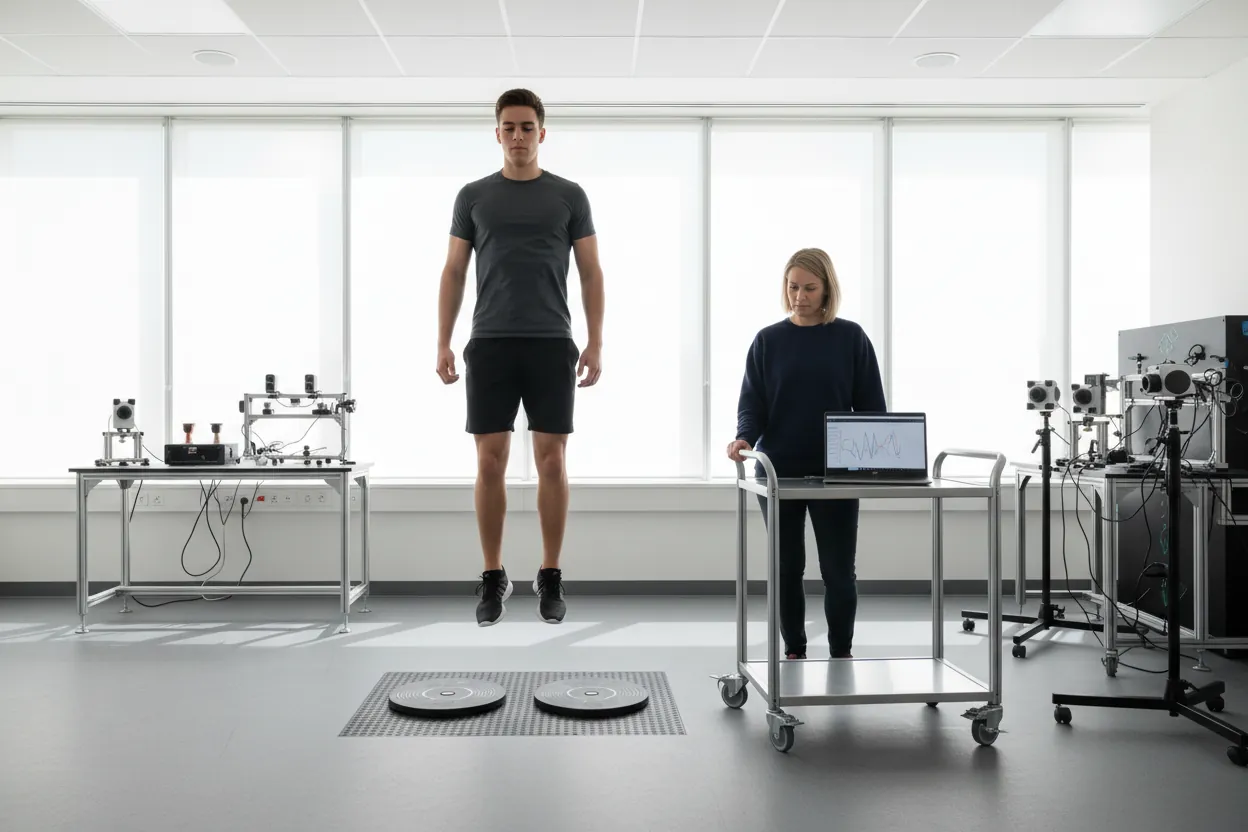
Picture a Tuesday in a college athletic department. Before practice, you run a short jump test on force plates, so you have a fresh reading for each player. During practice, wearable trackers log distance and speed. After practice, you clean the data, compare it with each athlete’s own history and flag the three players whose numbers moved the wrong way.
Then the sport scientist’s real work starts: you talk. You sit down with the head coach and the strength staff, show a chart and give a recommendation in plain words. Coaches don’t want a spreadsheet. They want to know who needs a lighter day.
The rest of the week is research review, equipment calibration and building the reports staff will open on Friday. NSCA says the exam includes case studies built around research review as well as athlete scenarios, because reading studies is part of the job.
How Do You Become a Sport Scientist, Step by Step?
Most people follow this order. Steps two and three usually overlap.
-
Earn a bachelor’s degree in a qualifying field. Sport science and exercise science fit best, and a bachelor’s in biology, physiology or psychology also counts toward the CPSS.
-
Get in a room with athletes. Volunteer, intern or work as a student assistant. NSCA’s own career ladder starts at intern or trainee, usually a college senior or recent graduate.
-
Learn the data side. Statistics, research methods and a programming language such as R or Python set you apart from people who only know training theory.
-
Decide whether a master’s fits. It’s the shortest path to the CPSS and the usual route to a coordinator job.
-
Earn the CPSS, the sport scientist credential. Apply, get your eligibility approved, then register for the exam.
-
Move up the sport scientist ladder. NSCA lists four levels: intern or trainee, coordinator (1 to 6 years of experience), director (7 or more) and senior director (10 or more).
If you’re starting from nothing, the first four steps take about four to six years. If you already hold a bachelor’s degree in a related field, you can skip ahead to a master’s.
What Is the CPSS, and Do You Need It?
The CPSS is NSCA’s most advanced certification. NSCA launched the exam in 2021, and it asks for more than a degree: you apply first, get approved, and only then register. You also need a current CPR/AED certification.
There are three routes, set by your degree.
| Your degree | Experience required |
|---|---|
| Bachelor’s in sport science or a closely related field | Three years of documented full-time professional experience beyond the internship level |
| Master’s in sport science or a closely related field | Twelve weeks (480 hours) of applied experience, including internships, fellowships, graduate assistantships or full-time roles |
| Doctorate in sport science or a closely related field | None |
That table is the strongest argument for a master’s degree. Three years of full-time work becomes 12 weeks, and a graduate assistantship counts toward it.
The exam itself has 100 scored questions plus 15 unscored pretest items, with 165 minutes to finish. It mixes athlete case studies, research-review case studies and standalone questions. A scaled score of 70 passes. NSCA reports that 68% of first-time candidates passed in 2025.
Fees run $25 to apply, then $340 for NSCA members or $475 for non-members. The application fee counts toward the exam fee. Once you hold the credential, you recertify every three years with continuing education.
Do you need it? Not for every job. NSCA says the CPSS is often preferred or required for roles such as coordinator, human performance lead and director. It also says Major League Soccer requires the CPSS for its mandated performance and sport scientist role. Read the postings for the jobs you want before you decide.
What Degree Does a Sport Scientist Need?
The CPSS names no single major. A bachelor’s, master’s or doctorate in sport science or a closely related field qualifies, and NSCA’s list of accepted majors is wider than most people expect:
- Exercise science
- Strength and conditioning
- Sport and performance analytics
- Athletic training
- Biomedical sciences
- Bioengineering sciences
- Health education and promotion
- Therapeutic exercise and fitness
- Allied health sciences
- Chiropractic
Underlying sciences count as well, including physiology, biology, chemistry, physics, neuroscience, psychology and bioenergetics.
If your degree isn’t on the list, you may still qualify. NSCA asks for coursework in four of six areas: biomechanics and human movement, physiological disciplines, coaching and psychology of sport, nutrition, strength and conditioning theory, and research methods and statistics. A communications major who took biomechanics, exercise physiology, nutrition and statistics has a case to make.
If you want the sport scientist title in your degree, search for a sports scientist degree under names like “sport science,” “performance and sports science” or “human performance.” Our online sport science and human performance ranking sorts 23 of them by cost, format and certification fit.
Can You Get a Sports Scientist Degree Online?
Yes. Of the 23 programs on that list, 18 are fully online and 5 have some in-person requirement. The master’s programs are the largest group at 17. Their listed tuition runs from $10,650 for University of the Cumberlands’ 30 credits to $30,078 for East Tennessee State University’s 36 credits at the out-of-state rate. Here are seven that fit the sport scientist path in different ways.
| Program | Level | Credits | Cost per credit | What fits the work |
|---|---|---|---|---|
| King’s College MS in Performance and Sports Science | Master’s | 36 | $765 | Built around the CPSS, with biostatistics and two digital projects; fully online |
| Lasell University MS in Applied Sports Science Analytics | Master’s | 36 | $756 | Python, R, machine learning and visualization for athlete data |
| University of Florida MS in Applied Physiology and Kinesiology | Master’s | 30 | $585.75 | AI and Sport Science concentration; no GRE |
| University of West Florida MS in Movement Sciences and Health | Master’s | 30 | $494.22 | Predictive Sport Performance Analytics course; thesis or capstone project |
| East Tennessee State University MS in Sport Science and Coach Education | Master’s | 36 | $835.50 | 240 supervised internship hours at a site you choose |
| University of Missouri BS in Sport Science | Bachelor’s | 120 | $707.50 in state, $841.70 out of state | Sport Science Lab with GPS monitoring, force plates and motion capture |
| Liberty University PhD in Health Sciences, Exercise and Sport Science | Doctorate | 60 | $630 | Dissertation research; the doctoral CPSS route needs no extra experience |
King’s College is the one to look at first if becoming a CPSS-certified sport scientist is your goal. The school says its 36-credit master’s is designed around the CPSS, runs 100% asynchronous and can be finished in two years. At $765 a credit, that’s $27,540. Lasell’s 36 credits at $756 come to $27,216, and its curriculum covers machine learning and interactive visualization.
University of Florida’s 30-credit master’s costs $17,572.50 and offers an AI and Sport Science concentration. The program says one of its strength and conditioning courses prepares you for the CPSS and the SCCC. If you want coursework tied to the CPSS, compare King’s College and University of Florida side by side.
At the bachelor’s level, University of Missouri’s online degree requires an internship and runs through a Sport Science Lab with GPS monitoring and force plates. At $707.50 a credit in state, 120 credits come to $84,900. If you already hold a bachelor’s degree, our online master’s in exercise science ranking lists more graduate options.
Where Do Sport Scientists Work, and What Are the Job Titles?
NSCA says CPSS holders work at universities, sport organizations and tactical training units. You may also find them on product development teams at wearable technology, athletic apparel and footwear companies.
Sport scientist job titles vary more than the work does. NSCA names these as roles where the CPSS is often preferred or required:
- Sport science coordinator or manager
- Human performance lead
- Director of sport science or athletic performance
- Director of sport performance and analytics
- Senior director of health and performance
- Senior research scientist (biomechanist, physiologist or data scientist)
When you search for sport science jobs, try each of those titles plus “performance analyst” and “athlete monitoring.” NSCA runs a job board where employers who prefer certified professionals post entry-level to senior roles.
Entry-level titles look different. Intern, apprentice and junior analyst are the usual first jobs, and NSCA ties them to college seniors and recent graduates. Coordinator roles are full-time staff positions inside an athletic or performance department.
How Much Does a Sport Scientist Make?
Start with a gap: BLS doesn’t publish a sport scientist wage. O*NET has no occupation by that name either. A keyword search for sport scientist returns exercise physiologists and coaches and scouts among its closest matches, so those are the nearest official categories.
The better number comes from NSCA. Its 2025 Salary Survey added performance and sport science for the first time and collected data from 3,177 participants worldwide. The average sport scientist earned $86,996. Level made the biggest difference.
| Level | Average salary |
|---|---|
| Assistants and interns | $52,678 |
| Managers and coordinators | $74,527 |
| Directors | $119,935 |
Setting mattered too. College and university positions averaged $102,284, independent and private roles $87,127 and professional sports $85,614. By sport, basketball-related positions averaged $140,450, baseball $109,281 and football $100,158.
Now the BLS side. Exercise physiologists, the closest category, had a May 2025 median of $59,460, with the middle half earning $49,620 to $67,230. The bottom tenth earned $42,760 or less and the top tenth $80,560 or more. BLS counted 8,560 of them. Our exercise physiologist salary page breaks that down by state.
Why are the two numbers so far apart? One is an average from an international survey that covered sport scientist jobs and strength and conditioning jobs. The other is a U.S. median across a broad occupation that includes clinical jobs. Neither is a quote for your first job, and the first job is usually the lowest rung on NSCA’s ladder.
What Are the Downsides of a Sport Scientist Career?
Working as a sport scientist can be a good job in a small field. Go in knowing these.
There’s no official job count. NSCA says statistics for applied sport scientist careers are scarce. It points to nearly every professional and many collegiate athletic programs having dedicated sport scientist roles or departments, but that’s a pattern, not a total.
Entry roles pay like entry roles. Assistants and interns averaged $52,678 in NSCA’s survey, and some internships are short-term. Plan for a lean first year or two.
The experience can’t be online. A sport scientist can learn statistics and physiology from home. You can’t learn to run a force plate session without athletes in front of you. A program with an internship, or an assistantship nearby, is worth more than a bargain tuition rate.
The bachelor’s route is slow. Three years of full-time experience beyond the internship level is a long wait, which is why many people add a master’s.
You may need to move. Sport scientist jobs cluster at universities and teams, and many of them aren’t in your town.
Which Route Fits Your Starting Point?
| If you’re | Next step | Where to look |
|---|---|---|
| Starting college | Pick exercise science or a sport degree and find a student assistant role early | Human performance degrees |
| Holding a bachelor’s in exercise science | Add a master’s with a data focus, then apply for the CPSS | Online master’s in exercise science |
| Holding a bachelor’s in psychology, biology or another science | Check NSCA’s qualifying list, then choose a master’s that adds sport coursework | Sport science and performance degrees |
| Coaching or training athletes already | Add the data skills and the CPSS to the experience you have | Degrees for athletes |
| Working as a strength coach | Pair the CSCS with the CPSS | CSCS certification guide |
If you want the clinical side of exercise science instead, read about becoming an exercise physiologist. And if you’re still deciding between degrees, check each program’s accreditation first with our accreditation guide.
How We Checked These Facts
CPSS routes, fees, exam facts, job titles and the 2025 salary survey figures come from NSCA’s own CPSS pages. Wages are BLS OEWS May 2025 as stored in our data, and the occupation match comes from O*NET OnLine. Program details come from each school’s pages, recorded in the program reviews linked above.
Requirements, fees and dates can change. Check NSCA’s CPSS page before you apply, and ask each school about its internship placement before you enroll.
Exercise Physiologists Pay by State
In May 2025, the Bureau of Labor Statistics reported a median annual wage of $59,460 for exercise physiologists nationwide, with the middle half earning between $49,620 and $67,230. About 8,560 people held these jobs.
Washington had the highest published state median at $81,310, and Mississippi the lowest at $43,060. The table shows the ten highest, and the state picker under it shows any other state where BLS publishes a median.
| State | Median | 10th Percentile | 90th Percentile | Jobs |
|---|---|---|---|---|
| Washington | $81,310 | $65,830 | $97,620 | 160 |
| Oregon | $71,630 | $56,010 | $81,260 | 80 |
| Minnesota | $67,230 | $61,640 | $95,140 | 250 |
| Massachusetts | $65,950 | $60,060 | $97,370 | 180 |
| New Jersey | $64,680 | $55,620 | $79,290 | 130 |
| Colorado | $63,800 | $45,210 | $75,350 | 370 |
| New Hampshire | $63,590 | $51,630 | $79,050 | 50 |
| Wisconsin | $63,210 | $55,100 | $77,320 | 340 |
| Connecticut | $62,510 | $46,570 | $81,740 | 100 |
| California | $62,440 | $36,970 | $106,290 | 640 |
Frequently Asked Questions
How Do You Become a Sport Scientist?
What Degree Does a Sport Scientist Need?
Is the CPSS Required to Work as a Sport Scientist?
How Much Does a Sport Scientist Make?
How Long Does It Take to Become a Sport Scientist?
Can You Become a Sport Scientist With an Online Degree?
Is a Sports Performance Analyst the Same Job as a Sport Scientist?
Sources
- CPSS: Certified Performance and Sport Scientist
- CPSS Eligibility Requirements
- CPSS Exam Description
- Hiring a Certified Performance and Sport Scientist
- Exercise Physiologists, 29-1128.00
- Occupation Keyword Search: Sport Scientist
- Occupational Employment and Wage Statistics, Exercise Physiologists
- Performance and Sports Science Master's Degree
- M.S. in Applied Sports Science Analytics
- Sport Science
All sources retrieved .