
Exercise science vs athletic training comes down to who you work with and what license you need. Exercise science is the study of how the body responds to exercise, and a bachelor’s opens fitness, wellness and clinical exercise jobs. Athletic training is a licensed health care profession that treats injuries, and it now takes a master’s degree plus the Board of Certification (BOC) exam.
What Is the Difference Between Exercise Science and Athletic Training?
Athletic training is a health care job. The National Athletic Trainers’ Association (NATA) describes it as an allied health care profession covering the prevention, examination, diagnosis, treatment and rehabilitation of emergent, acute or chronic injuries and medical conditions. Athletic trainers work under the direction of, or with, a physician.
Exercise science is a field of study, and the jobs that come out of it vary. The American College of Sports Medicine (ACSM) says exercise physiologists run fitness assessments and write exercise prescriptions for people who are healthy or have medically controlled diseases.
So the trainer fixes and manages injuries. The physiologist tests and improves how someone’s body handles exercise. Here’s the athletic training vs exercise science comparison side by side.
| Exercise Science | Athletic Training | |
|---|---|---|
| Core question | How does the body respond to exercise? | How do you evaluate, treat and rehab this injury? |
| Typical client | Healthy adults, clients with heart, lung or metabolic conditions | Athletes and other active people who are hurt |
| Degree to start | Bachelor’s | Master’s from a CAATE-accredited program |
| Credential | Optional certifications, such as the ACSM Certified Exercise Physiologist (ACSM-EP) | BOC certification plus a state license |
| Studying online | Common, at every level | Limited for entry-level programs |
| Median pay (BLS, May 2025) | $59,460 for exercise physiologists | $62,520 for athletic trainers |
CAATE, in that table, is the Commission on Accreditation of Athletic Training Education. It’s the accreditor that matters for the athletic training side.
How Does an Athletic Trainer Differ From an Exercise Physiologist?
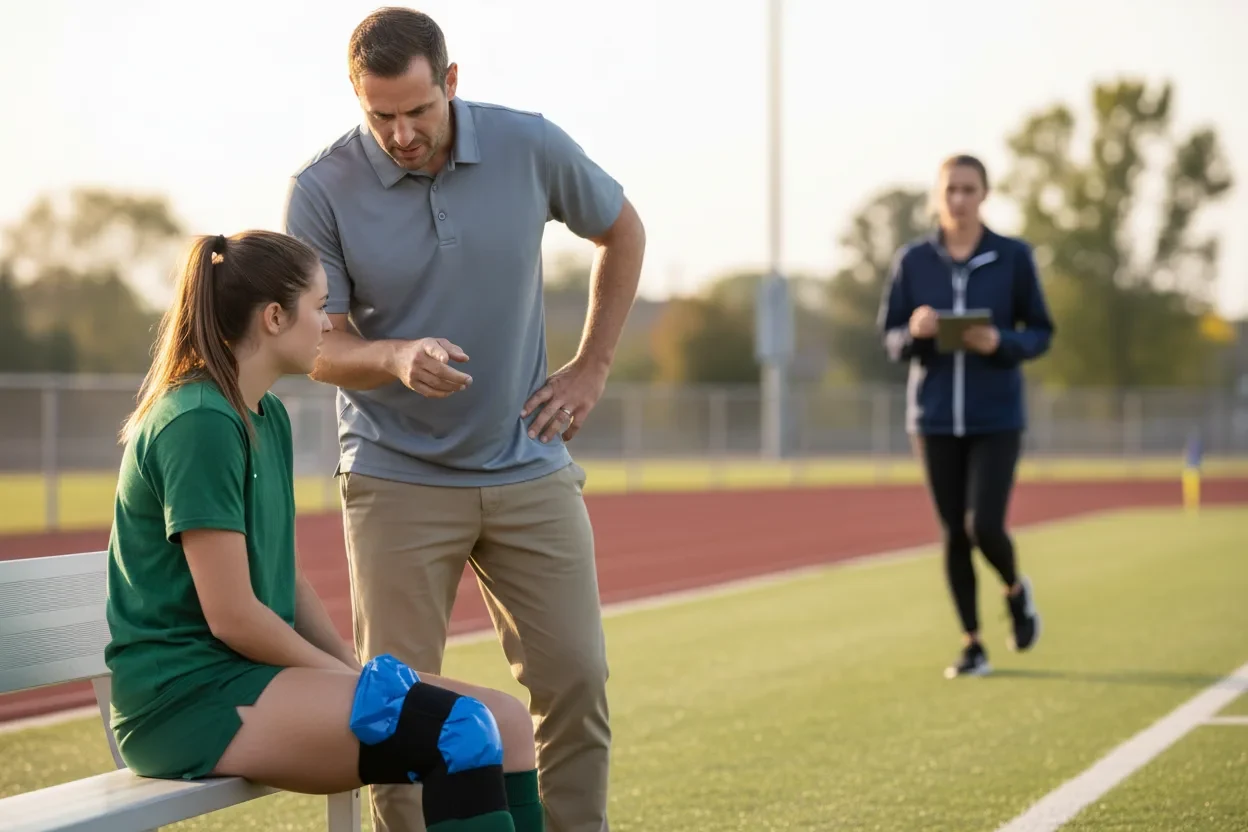
The athletic trainer vs exercise physiologist question is really about what happens in a normal workday. O*NET, the federal occupational database, lists tasks for athletic trainers like conducting an initial assessment of an athlete’s injury and deciding whether to refer to a physician. Others include evaluating whether an athlete is ready to play, taping, and building rehab programs with physicians.
O*NET’s exercise physiologist tasks look different. They include interviewing participants about their medical history, conducting stress tests on EKG machines, measuring oxygen consumption with spirometers, and prescribing individualized exercise programs.
Picture a Tuesday for each. The athletic trainer is at a practice field at 3 p.m., watching a player limp off and deciding what to do about the ankle. The exercise physiologist is in a hospital gym at 10 a.m., walking a heart patient through a supervised workout while checking heart rate and blood pressure.
Those two people might both love anatomy. They just don’t spend their days on the same problem. One works on what went wrong. The other works on how the body performs and recovers.
Can You Become an Athletic Trainer With an Exercise Science Degree?
You can start there, but you can’t stop there. To earn BOC certification, the BOC says you must complete an entry-level athletic training program accredited by CAATE and pass the BOC exam. And NATA states that the current minimum entry point into the profession is the master’s level.
Athletic training used to be a bachelor’s-level path. It isn’t anymore. Fresno State’s kinesiology department, for one, notes on its FAQ page that its BS in Athletic Training is no longer accepting students.
So the realistic route is a bachelor’s degree, then a master’s of athletic training. Here’s what that takes:
-
Finish a bachelor’s degree with the right prerequisites. Hardin-Simmons University’s catalog lists prior knowledge in anatomy and physiology, chemistry, physics, kinesiology and biomechanics, exercise physiology, nutrition, psychology and statistics.
-
Log observation hours. Both entry-level programs on our list ask for 50 hours with a certified or licensed athletic trainer.
-
Get into a CAATE-accredited program. CAATE keeps a directory of accredited programs with BOC pass rates, retention and placement data, so you can compare schools before you apply.
-
Pass the BOC exam, then get your state license. More on that below.
If you’re in the middle of choosing a bachelor’s, read the program’s pre-health language closely. United States Sports University says its Allied Health track in the Exercise Science BSS is built to meet prerequisite coursework for graduate athletic training programs, and it warns those programs also require observation hours.
Others are more blunt. Oregon State’s online Kinesiology BS says it isn’t designed for students who want allied health careers, and it lists athletic training by name. It’s a fine degree for other goals. It isn’t your prerequisite route.
Where Does Kinesiology Athletic Training Fit In?
Kinesiology is the umbrella, and athletic training is one profession that sits under it at many schools. The University of Wisconsin-Madison’s kinesiology department, for example, runs a graduate athletic training program and calls athletic trainers frontline health care providers.
That’s why searches for kinesiology athletic training turn up so many mixed results. Some pages are about a kinesiology bachelor’s you take before an athletic training master’s. Some are about the accredited athletic training program itself. And some are about a concentration with athletic training in its name.
That last one deserves a question. Tarleton State University’s Kinesiology BS lists an Athletic Training concentration next to Exercise and Sport Studies. The school describes the degree as a foundation for graduate athletic training programs, and it says it’s offered on campus, hybrid or online without saying which concentrations run online.
Ask any school with an “athletic training” concentration two things: is the program CAATE-accredited, and does it make you eligible for the BOC exam? If the answer to either is no, you’re looking at a prerequisite degree. That’s still useful. It just isn’t the full path.
Our kinesiology degree ranking lists 53 online programs, and the exercise science vs kinesiology guide explains how those two degrees differ.
How Do the Credentials and Licenses Compare?
They work differently, and the athletic training side is stricter. Athletic trainers need a license. The BOC reports that 49 states and the District of Columbia regulate athletic training, and that the BOC exam is accepted by every one of those regulators. It also warns that BOC certification doesn’t guarantee a license, so your state board has the last word.
Exercise physiologists work with a certification instead. The ACSM-EP is a credential from ACSM, and it asks for a bachelor’s degree in exercise science, exercise physiology or kinesiology plus adult CPR/AED, and the exam costs $460 or $350 for ACSM members.
One deadline matters here. Starting August 15, 2027, ACSM says ACSM-EP candidates must graduate from a program accredited by CAAHEP (the Commission on Accreditation of Allied Health Education Programs), or one that has started the accreditation process. Our ACSM exercise physiologist guide has the details.
That rule makes a program’s accreditation part of your decision now. Only four programs on our list hold CAAHEP accreditation today, and our certification-ready ranking shows them next to programs with other credentials.
How Do Pay and Job Growth Compare?
Very close, with different price tags to get there. Here are the BLS Occupational Employment and Wage Statistics (OEWS) figures for May 2025, plus O*NET’s projections for 2024 to 2034.
| Athletic Trainers | Exercise Physiologists | |
|---|---|---|
| Jobs nationwide | 30,500 | 8,560 |
| Median pay | $62,520 | $59,460 |
| Middle range (10th to 90th percentile) | $48,180 to $88,760 | $42,760 to $80,560 |
| Projected growth, 2024 to 2034 | Much faster than average | Much faster than average |
| Projected openings | 2,400 | 1,700 |
| Typical education | Master’s, CAATE-accredited | Bachelor’s |
The median gap is $3,060, which is $62,520 minus $59,460. Divide that by 12 and it’s $255 a month before taxes, for an extra degree and a licensing exam.
Where you live matters more than which job you pick. Athletic trainers in California have a median of $78,490. In Alabama it’s $46,940. Read our athletic trainer salary page for the state-by-state numbers, and the exercise physiologist career guide for the other side.
Also note the job counts. Athletic training employs more than three times as many people, so there are more places to look. The exercise physiologist job title is small, and lots of exercise science graduates end up in personal training, coaching or wellness roles instead.
Can You Study Athletic Training or Exercise Science Online?
Exercise science, yes. Athletic training, only in pieces. We list 168 online programs, and seven of them are athletic training. Only two of those lead to BOC eligibility, and both put you on campus for part of it.
| Program | Type | Online catch | Cost |
|---|---|---|---|
| Hardin-Simmons University MAT | Entry-level master’s, 77 credits | Six one-week campus lab intensives in Abilene, then full-time in-person clinicals in year two | $595 per credit, $45,815 total (77 credits) |
| Culver-Stockton College MAT | Entry-level master’s, 56 credits | Year one is on campus, year two is online with clinical immersion anywhere in the continental U.S. | $415 per credit, $23,240 before fees (56 credits) |
| A.T. Still University MS | Post-professional master’s, 30 credits | Fully online, but it doesn’t lead to BOC eligibility | $690 per credit |
| Ohio University DAT | Post-professional doctorate, 42 credits | Fully online, no campus visits | $593 per credit |
| Temple University DAT | Post-professional doctorate, 36 credits | Offered entirely online | $1,225 per credit, $44,100 total |
Read the two entry-level rows again. Hardin-Simmons markets its degree as the nation’s first online Master of Athletic Training, and it still asks for a minimum of 300 clinical hours per semester in year two, at sites in at least three setting types. Its cohort holds 16 students. The school says 90% of its 2021 and 2022 graduates passed the BOC exam on the first attempt.
The three post-professional programs are for people who already hold the BOC credential. A.T. Still’s master’s says outright that it doesn’t lead to eligibility for the BOC exam, so don’t confuse it with a way in.
On the exercise science side, our rankings hold plenty of fully online options. Northeastern State University’s Health and Human Performance BS is CAAHEP-accredited, costs $279 per credit, which makes $33,480 across its 120 credits. For a master’s with clinical training, Lebanon Valley College’s Clinical Exercise Physiology MS has three campus weekends and a 600-hour clinical internship.
Those doctoral options also show up on our online doctorate ranking, and the clinical exercise physiology master’s programs have their own list.
Which Path Fits You Better?
Match the path to the work you can picture doing on an ordinary Tuesday, and not to the title.
Choose athletic training if you want to treat injuries. You’d be on the field, court or clinic floor, making calls about who plays and who gets referred. You’ll need a master’s, real clinical hours and a state license. If that sounds right, start with observation hours before you pay for anything.
Choose the exercise physiologist route if you like testing and prescribing. Stress tests, fitness assessments and exercise plans for people with heart or metabolic conditions all start with a bachelor’s degree. If you’d rather do the clinical version, look at the clinical exercise physiology master’s programs.
Choose strength and conditioning if you want to coach performance. That’s a third path, and it has its own credential, the Certified Strength and Conditioning Specialist (CSCS). Our CSCS guide covers the exam and the 2030 degree rule.
Stay flexible if you’re unsure. A bachelor’s in exercise science or kinesiology that covers the athletic training prerequisites keeps the master’s open. It also keeps physical therapy open, which is a different, longer path. Our exercise science vs physical therapy guide compares them.
What Are the Downsides of Each Path?
Athletic training costs more time and less freedom. You’ll add roughly two years and a full clinical load, and those clinicals happen in person even in programs that market themselves as online. Hardin-Simmons’ year two is 30 or more hours a week. Cohorts can be small, too, and the pay is in the same range as a bachelor’s-level job.
Then there’s the schedule. O*NET lists traveling with athletic teams to be available at sporting events as a task, and games happen when other people are off. Ask any program to connect you with a current athletic trainer and hear about their hours.
The exercise science path has its own trouble. The direct-title job, exercise physiologist, employs 8,560 people nationwide, so plenty of graduates start in adjacent roles. The 2027 CAAHEP rule also means a degree from a program that isn’t accredited, or in the process, won’t qualify you for the ACSM-EP. And if your goal is physical therapy, an online bachelor’s may not cover lab prerequisites.
Neither path is a shortcut, and neither guarantees a job. Both reward people who get hands-on experience early.
What Should You Check Before You Enroll?
Send these questions to any admissions office, and save the answers in writing:
-
Is this program CAATE-accredited, CAAHEP-accredited or neither?
-
Does it make me eligible for the BOC exam, the ACSM-EP, or only prepare me for graduate school?
-
Which athletic training prerequisites does the degree include, and which do I finish elsewhere?
-
What happens in person, and who arranges the site for clinical or internship hours?
-
What do graduates do six months after finishing, and does the school publish it?
If a school answers “we prepare you for athletic training” and never mentions CAATE, ask again. The accreditation is what counts.
How We Checked These Facts
We read NATA, BOC, CAATE and ACSM pages on September 29, 2026, along with O*NET for tasks and projections. Wages come from BLS OEWS, May 2025. Program details come from each school’s own pages, recorded in the program reviews linked above.
Rules and fees change, so confirm figures on the source pages before you register or enroll. If a school page contradicts something here, tell us.
Frequently Asked Questions
Can You Become an Athletic Trainer With an Exercise Science Degree?
What Is the Difference Between an Athletic Trainer and an Exercise Physiologist?
Do Athletic Trainers or Exercise Physiologists Make More?
Can You Get an Athletic Training Degree Online?
Is Kinesiology the Same as Athletic Training?
Do You Need a License to Work as an Athletic Trainer?
Is an Athletic Training Degree Worth It?
Sources
- Athletic Training Education Overview
- What Is Athletic Training?
- Steps to Becoming Certified
- State Regulation
- Resources for Students
- Exercise Physiologist Certification
- Programmatic Accreditation Requirement
- Exercise Science Committee on Accreditation
- Athletic Trainers Summary Report
- Exercise Physiologists Summary Report
- Occupational Employment and Wage Statistics, May 2025
- What Is Athletic Training? Where Do ATs Work?
All sources retrieved .